
Answers for the first portion of the course are from Math And You
Lesson 1 1.1 Checkpoint
- $243.71 Add together all the expenses and subtract off all the payments.
- 88 teaspoons (worked out) 35 calories in a serving (worked out)
- choice D
- 16 boxes (worked out) $1468.80 (worked out)
- 70 minutes (total calories divided by calories burned per hour) (worked out)
- greater than (worked out – one, two, $2304 is 4%)
Lesson 2 1.1 Exercises
1. $47.08 (worked out)
3. $39.41 (worked out)
5. 1360 calories in recipe and 150 per serving (worked out – one, two, fraction/decimal help)
7. 3810 (worked out) $310 (worked out)
9. $40 (worked out)
11. $806 Total cost: $834 Area Number of 10-pound bags Total Cost
13. about 8 and a half minutes (worked out)
15. between 6.7 and 18.7 minutes (worked out steps: one, two, three, four)
17. 36,049 mph (worked out)
Lesson 3 1.2 Checkpoint
- $1129 (worked out)
- Miles divided by gallons c. 45 m/g d. 18 m/g
- Answer image
- 16 gigabytes (worked out)
- E and F are okay. D could be: The weight of an athlete is about 215 pounds.
- 15 characters, This uses the average length for a first and last name. (worked out)
Lesson 4 1.2 Exercises
1. 3,900,000,000,000 kilowatt hours
3. about 13,000 kilowatt hours per person (worked out)
5. $12 a year (worked out)
7. The difference is $140 over 7 years. Multiply each year’s cost by 7. (worked out for the current fridge)
9. meso plankton (worked out)
11. femto plankton (worked out)
13. about 25 million (can’t know exactly)
15. about 5 pounds
17. area of the living room is 297 square feet, so buy 300 sq feet (worked out) and multiply by the price per square foot to get total price $1047 (worked out)
Lesson 5 1.3 Checkpoint
- 395, 218 miles squared (worked out)
- 94,594,500 cats (worked out)
- 41% (worked out)

- answers will vary
- answers will vary
Lesson 6 1.3 exercises
1. 67,860,000 American men (worked out)
3. Add the populations and then estimate: 9,600,000 adults with no opinion (worked out)
5. 1,236,690 people (worked out part 1, part 2)
7. (skipped)
9. 73.7% (worked out)
11. 4.9% (worked out)
13. 51.5% Add the number of bones to get 106 then… (worked out)
15. 18.75% (worked out)
17. 0.5 carat is $971 through $2026 (worked out), 1 carat is from that through $6892 (worked out), 2 carats through $16,092 (worked out).
19. $14,066 (worked out part 1, part 2)
21. 67% (worked out)
23. a) 1 = 100% b) 1 = 100% c) .5 = 50% (worked out part a, part b, part c)
Lesson 7 1.4 Checkpoints
1. $1,181,180 (worked out)
3. c) Approximately 14.6 d) 131.2 (worked out part c, part d)
5. 31,556,925,19 (worked out)
7. c) About 40s d) About 30s
9. c) $4.24 (worked out)
11. a) 68 degrees b) 25 degrees
Lesson 8 1.4 Exercises
1. $2.45 (worked out)
3. 3-5 days = $12.47, 2 days = $23.14, savings = $10.40 (worked out 1, 2, 3)
5. 1 day $300.51, 2 days $141.51, 3-5 days $77.91 (worked out 1, 2, 3)
7. b. It will take 72 mins (worked out 1, 2)
9. 0.625 lb (worked out)
11. Approximately 5.47 qt/1 min (worked out)
13. 0.8 sec. (worked out)
15. Approximately 20,321.52 ft (worked out)
17. Approximately 10.007 ft/min (worked out)
19. 156.2 (worked out)
21. Method 1 $352.63, method 2 $352.57 The difference in the dollar amounts is due to round-off error. In either case, the cost of the product is about $352.60. (worked out 1, 2)
23. Approximately $53.98 per tank (worked out method 1, method 2)
Lesson 9
Extending Concepts 33
25. When you lose 20% of $1250, you lose $250. Your investment is now worth only $1000. If you gain 20% during the second year, then you will have gained $200. (worked out 1, 2)
31. 92% (equation, spreadsheet 1, 2)
Extending Concepts 43
21. Approximately $352.63 with method 1, and $352.57 with method 2 Difference due to round off error. (worked out method 1, 1, 2, method 2, 1, 2)
23. Approximately $53.98 with method 1, and $53.97 with method 2. Again, the difference is due to round off error. (worked out method 1, 1, 2, method 2, 1, 2)
Part 1-2
1. b. (worked out, each step 1, 2, 3, 4, 5, 6, 7, 8 The problem with a. What b. is doing)
3. Using total area 3.4 people per km squared. Using land area (9,093,507 km squared) 3.75 people per km squared. (worked out total area, land area 1, 2)
5. Approximately 3968 people per km squared. (worked out)
Part 3-4
1. 14,040,000 people (worked out)
3. As they get older they are more likely to become disabled (U.S. Pop. by Age)
5. 60 in. (worked out)
7. 12 furlongs (worked out)
Lesson 10
1. a) Correct (worked out); b) Not correct (worked out)
3. 3.5 hr (solution using unit analysis, here is a solution using the formula t=d/r)
5. 1875 miles, for eight years it’s 234.375 miles per year (worked out 1, 2)
7. 19,500,000 barrels of oil per day (worked out)
9. China consumed around 7,800,000, which is 0.006 barrels of oil per person per day, and 0.252 gallons of oil per person per day. The USA consumed about 0.064 barrels of oil per person per day, and around 2.688 gallons of oil per person per day. (worked out China, 1, 2, 3, USA, 1, 2)
11. 520,000 barrels of oil per day, 189,800,00 for the entirety of 2008 (worked out 1, 2)
13. 9,975,00 cubic miles (worked out)
15. 51.6% (worked out)
17. 29,925 cubic miles of fresh surface water. If the melting of icecaps and glaciers added 6000 cubic miles to this surface water, then that would be a percent change of 20.1% (worked out 1, 2)
19. Earth’s water occurs as:
- Oceans
- Icecaps and Glaciers
- Ground water (wells, aquifers)
- Surface water (rivers, lakes, ponds, wet lands, streams)
What else is there? The answer is that water also occurs in the atmosphere and in the bodies of plants and animals.
21. 7.83 knots (worked out)
23. 3.45 miles (worked out)
25. 30 ft (worked out)
Lesson 11
Unit Prices
1. Caviar = $106.71/oz, Wrinkle Cream = $70.00/fl oz, Honey = $1.31/1 oz (worked out 1, 2, 3)
Checkpoints
1. c) $2.15 per gallon of milk d) 41% (worked out c, d)
2. Homemade = $0.01 per load Brand B = $0.14 per load (worked out 1, 2, 3, 4)
3. Around $0.055 (worked out 1, 2)
5. d) $2.75 e) $20.80 (worked out d 1, 2, e 1, 2)
Lesson 12
1. About $0.174 (worked out)
3. About $0.05 per fluid ounce (worked out)
5. a) $0.98 b) 38.1% (worked out a, b)
7. Brand B is best because it’s cheapest (worked out)
9. a) $0.07 per fluid ounce b) Because it results in a lower unit price. Other reasons could include tradition or a government regulation. (worked out)
11. $55.73 in savings (worked out)
13. a) $17.56 b) $45.75 per year (worked out a, b)
Lesson 13
Checkpoints
1. c) 10% d) 240% (worked out c, d)
2. No, it uses the wrong denominator. The real markup is 42.9% (worked out 1, 2, 3)
3. The average markup percent for selling the 25 shirts is about 124%. Note About Round-Off Error: In the spreadsheet, note that some of the amounts shown in column F are not the product of columns D and E. This result is due to round-off error. You can avoid this type of error by using a “greatest integer function (INT)” when listing the prices in column D. (worked out)
4. Best way is to use a spreadsheet (worked out)
5. The final price of the jeans is $27. This is a total discount percent of 32.5% (worked out 1, 2)
6. $57.80 per hour (worked out 1, 2)
Lesson 14
1. 122% markup (worked out method 1, method 2)
3. 64% markup (worked out method 1, method 2)
5. 20$ markup (worked out 1, 2)
7. 48.1% (worked out spreadsheet, average markup)
9. a) 3 b) You spent $910 to buy the statues. You can make a profit as long as your total revenue for the 26 statues is greater than $910. It doesn’t matter that you eventually sold 5 of the statues at cost and another 3 statues below cost. (worked out a, b)
13. a) $298 b) $301.75 (worked out a, b)
15. a) 25% b) $17.94 (worked out a, 1, 2 b, 1)
Lesson 15
Checkpoints
1. c) $15 d) $99.99 (worked out c, d)
2. a) Total lost sales tax per year would be around $650,000. b) $155 billion (worked out a, b)
3. $63 billion (worked out)
4. c) $25,346,000,000 d) 40.6% (25,246,000,000/62,483,000,000 = 0.406 = 40.6%) e) A plan could include an increase in the excise taxes for alcohol, gasoline, cigarettes, and gambling. (worked out c)
5. a) $31.60 b) $31.60 (worked out a, b)
6. a) The total taxes are $170 billion, and the percent represented by individual income tax is 30.6%. This is less than the percent for individual income taxes for the federal government. b) The percent represented by corporate income tax is 6.5%. This is less than the percent for corporate income taxes for the federal government. (worked out a, 1, 2 b, 1)
Lesson 16
1. $103.87 (worked out)
3. 6% (worked out)
5. You can save $37.77 by buying the painting in Alabama (worked out 1, 2, 3)
7. 1.2% City sales tax, 6% State sales tax (worked out 1, 2)
9. Least Wyoming, greatest Alaska
11. $0.6 (worked out)
13. A keg of beer contains 15.5 gallons. The total excise tax on a keg of beer in South Carolina is $20.89, of the total purchase price of $110, the percent that goes to excise tax is 19% (worked out 1, 2)
17. $24,380 (worked out)
19. Using a value-added tax, the retail price for the consumer would be $36,805, using a sales tax of 8.25%, the retail price for the consumer would still be $36,805 (worked out 1, 2, 3)
21. Gasoline excise tax in the United States is about 9% of the gasoline excise tax in Germany (worked out 1, 2, 3, 4)
Lesson 17
Checkpoints
1. -$3.54, $4.30 (worked out)
2. The total of the difference column is ―$448.47, which means that you spent $448.47 less than you budgeted. (worked out)
3. (worked out)
4. $225 (worked out)
5. 15%, 12.5 (worked out 1, 2)
Lesson 18
1. 0, because both numbers are the same
3. $3055 (worked out)
5. $69.5 (worked out)
7. $250 (worked out)
9. $540.26 (worked out)
11. Check #220 (worked out)
13. $319.01 (worked out)
15. $54,000 (worked out)
17. Around 6%, you could divide every budgeted income by $4500, or just estimate from the graph (worked out)
21. According to the Household Budget Guidelines, your budget is looking good. You are keeping your expenses under the guideline percents. Here are your areas of concern. You only set aside 5% for retirement. This is half the recommended amount. If you combine 1.1% for clothing with 5.4% for miscellaneous, you get a total of 6.5%. Comparing this to the miscellaneous recommendation of 2-4%, your budget is about double the recommended amount.
Lesson 19
Extending Concepts 83
25. One state in which this transaction could have occurred is Pennsylvania. It has a 6% state sales tax on “nonneccessities.” Necessities, such as ordinary groceries and ordinary clothing, are tax exempt. (worked out)
Extending Concepts93
23. You should plan on a monthly expense of $50. To make your budget run smoothly, you need to set aside $50 months before your quarterly gym membership is due.
25. In broad terms, you really have only two options. Cut $400 from other monthly budgeted items, or increase your monthly income by $400 or more.
If you choose the first option, be sure you consider the consequences of cutting from your budgeted amounts for retirement and for savings. There are many websites that offer suggestions for economizing expenses on a reduced budget.
27. From the portion of the bank statement, it is clear why you should account for the bank fees in your checkbook registry. In the month shown, you paid a total of $11.50 in fees. These were deducted on the days that each occurred.
Your balance on 7/7/12 was only $2.91. If you had not entered the fees into your checkbook registry, then you would think your balance was $11.50 + $2.91 = $14.41. Writing a check for any amount over $2.91 would result in an overdraft and a potentially high overdraft fee.
Quiz 1
1. Brand A has the greatest unit price. Brand C has the least unit price. (worked out)
3. $1 markup, 101% markup percent (worked out 1, 2)
5. $0.014 per fl oz. the discount percent is 84.9% (worked out 1, 2, 3, 4, 5)
Quiz 2
1. State 4.5%, county 1.0% (worked out 1, 2, 3)
3. State excise tax on gasoline $1.70, state excise tax rate on gasoline 5.5% (worked out 1, 2)
5. $552.35 (worked out)
Lesson 20
Review Exercises
1. 2 Liter bottle = $0.013 per fl oz, 6-pack $0.027 per fl oz, case = $0.026 (worked out 1, 2, 3, 4)
3. $360, but of course, the family could save almost $700 a year by drinking tap water instead of soda. (worked out 1, 2, 3, 4, 5, 6)
5. When you move bubble A up, you are increasing its price. Because the volume remains constant at 20 fluid ounces, the unit price is increasing. Consequently, the bubble will get larger as the price increases.
7. Brand B gives you the most soda per dollar
9. $60 (worked out)
11. $30 (worked out)
13. 25% (worked out)
15. $49.50 (worked out)
17. $0.16 (worked out)
19. $6.52 (worked out)
21. A value-added tax is a type of ad valorem tax, which means that it is a percent of the value. An excise tax is normally based on the quantity being sold (gallons of gasoline or packs of cigarettes), and is not dependent on the price of the gasoline or cigarettes.
23. (worked out)
25. Your actual cell phone expenses are consistently coming in above your budget. You have four basic options for correcting this. Increase your budgeted amount to about $135 a month, lower the amount you use your cell phone, talk to your cell phone provider about switching to a cheaper plan, or switch providers to a company that has a cheaper plan
27. Most banks would probably determine that you qualify for the home mortgage (worked out 1, 2, 3)
Lesson 21
Checkpoints
2. h. 49 i. 67 j. 13 k. 1 (worked out 1, 2, 3, 4)
4. Using the hypothesis that any two people have a 20% likelihood of matching one and two fingerprint points, there are up to 20 people out of a billion that have a 12-point match.
5. 5.8% (worked out)
6. (worked out)
Lesson 22
Exercises
7. 12 with enrollments of less than 2000, 3 of these have a tuition that is less than $20,000 a year (worked out 1, 2, 3)
9. (worked out)
11. 6 (worked out)
13. 4 (worked out)
15. 14 (worked out)
21. The set diagrams in Exercises 17 and 19 show that in 2010, the U.S. had 1968 strategic warheads and Russia had 2504 strategic warheads. Because START is an agreement to reduce strategic weapons, one would expect both of these numbers to drop. (worked out 1, 2)
Lesson 23
Checkpoints
1. (worked out)
2. You could use any number of diagrams or graphics to help understand this clause. Whatever you do, it should be clear that the clause is one-sided and greatly favors the owner. Note that you might have to pay for other legal fees, in addition to the ones specified by your renter’s agreement. (worked out)
3. (worked out)
4. (worked out)
5. Original Statement: “The 3 cards in the envelope are Miss Scarlet, the Wrench, and the Kitchen.” Negation of Statement: “One of the cards, either Miss Scarlet or the Wrench or the Kitchen is in my hand or another player’s hand.” (worked out)
6. The original statement will be false if I do not write a term paper or I write about some other topic. (worked out)
Lesson 24
Exercises
1. When you are using a set diagram to help analyze and understand a statement, remember that your goal is to analyze and understand the statement! The goal is not to draw a certain style or type of set diagram. Most people who use set diagrams effectively develop their own style. For some people, the style is informal … more like doodling than formal mathematics. With that said, here are a couple of ways that the statement can be represented with a set diagram. (worked out 1, 2)
3. To begin, you need to make an assumption as to what the phrase “all individuals” means. One would guess that this means “any human being.” So, the statement says nothing about dogs, horses, or other animals. (image 1, 2, 3). Stating something clearly so that it is understood in only one way is difficult. That is why there are attorneys who work at writing contracts and other statements. It is also why we have courts, such as the Supreme Court, whose job it is to decide exactly what is meant by legal documents.
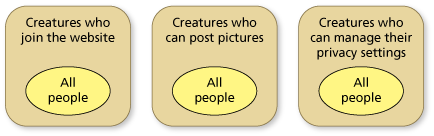
5. There are many ways to use set diagrams to help analyze statements like this. If a single diagram becomes too cumbersome, you might find it more helpful to analyze parts of the statement separately. This set diagram makes it clear that: (a) All unauthorized contests will be terminated. (b) Other things can be terminated, too. This set diagram makes it clear that: (a) Unauthorized contests on the website are considered illegal activity. (b) There can be other types of illegal activity.
7. (image)
9. (image)
11. (image)
13. (image 1, 2)
15. (image)
Lesson 25
Checkpoints
1. Here is one possible syllogism: Premise 1 – Any physical theory is always provisional in the sense that it is only a hypothesis; you can never prove it. Premise 2 – Any theory of gravity is a physical theory. Conclusion – You can never prove any theory of gravity.
2. Here is a possible syllogism: Premise 1 – All men are innocent in their own eyes. Premise 2 – John is a man. Conclusion – John claims to be innocent. Or another possibility: Premise 1 – Everyone arrested for a crime claims to be innocent. Premise 2 – John was arrested for a crime. Conclusion – John claims to be innocent.
3. Here is Euclid’s 5th Postulate: Parallel Postulate At most one line can be drawn parallel to a given line through a given point not on this line. Premise 1 – Given a line and a point not on the line, there is at most one line that passes through the point and is parallel to the given line. Premise 2 – You are given a line and a point not on the line. Conclusion – There is at most one line that passes through the point and is parallel to the given line.
4. In spherical geometry, it is also true that a triangle is determined by 3 intersecting lines (great circles). The question is, is the sum of the 3 angle measures less than 180 degrees, equal to 180 degrees, or greater than 180 degrees? You might try conducting an experiment to measure the 3 angles. To do this, you must be sure that each of the 3 sides is a great circle. You also need to take very careful measurements of the angles. If you perform this experiment, you will discover that the sum of the angles measures greater than 180 degrees. (worked out)
5. Although this is valid inductive reasoning, the conclusion is not correct. Some tigers are white with black stripes. Others are pure white. (worked out)
6. One can hardly pick up a newspaper or news magazine without reading about other examples of inductive reasoning related to environmental issues. Here are a few examples.
- Overpopulation by humans, which many environmentalists agree is the primary problem.
- Global warming, which is a result of overpopulation.
- Indirect threatening of animal species by destruction of habitat.
- Direct threatening of animal species by fishing and hunting.
- Poisoning of the environment through garbage, plastics, and toxic waste.
Lesson 26
Exercises
1. Conclusion – All segregated public schools are unconstitutional. (worked out)
3. Premise 1 – If an ordinary law conflicts with the Constitution, then because the Constitution is superior to ordinary law, the Constitution will govern the case to which they both apply. Premise 2 – An ordinary law conflicts with the Constitution. Conclusion – The Constitution will govern the case to which they both apply.
5. Premise 1 – All unequal treatment of individuals based on gender is unconstitutional. Premise 2 – The Virginia Military Institute’s male-only admission policy was an unequal treatment of individuals that was based on gender. Conclusion – The Virginia Military Institute’s male-only admission policy was unconstitutional.
7. Premise 1 – If any resident of a house objects to a police search without a warrant, then it is unconstitutional for the police to search the house. Premise 2 – In the case of Georgia v. Randolph, one resident objected to a police search of the house without a warrant. Conclusion – The police search of the house without a warrant was unconstitutional (regardless of the fact that another resident of the same house agreed to the search).
9. To answer this question, you need to consider that a logical system is being developed. In this system, you can assume that ordinary English words and concepts are known. However, words and concepts that seem special to the system must be considered undefined. In this postulate system, it is reasonable to assume that the terms “town” and “road” are undefined.
11. Premise 1 – If there are two towns, then there exists a road that passes through them. Premise 2 – There exist two towns. Conclusion – There is a road that passes through the two towns. (worked out)
13. Step 1: There exist two towns. – Premise 3 Step 2: There exists a road passing through the two towns. – Premise 1 Step 3: There exists a town which the road does not pass through. – Premise 2 Step 4: The town in Step 3 is different from the towns in Step 1. – A road can’t pass through a town and also not pass through it. Step 5: So, there exist at least three towns. – Follows from steps 1 and 4. Do you remember this type of deductive reasoning from high school geometry? Notice that each step must be justified using a premise, logic, or a previously used step.
15. To decide whether the postulates guarantee the existence of a town at the intersection of any two roads, try drawing a system in which this is not true. Then, check the system to see whether the postulates are still valid. If they are, then you can conclude that the postulates do not guarantee the existence of a town at the intersection of any two roads. (worked out)
17. In each case, you can use inductive reasoning to infer that each type of dinosaur lived only in the regions where its fossils have been found.
Troodon: Conclusion based on pattern
- The only places that Troodon fossils have been found are Wyoming, Montana, Alberta, and Alaska.
- Therefore, the only places that Troodon lived were Wyoming, Montana, Alberta, and Alaska.
It’s the same for the rest of them as well (worked out 1, 2, 3)
19. Giganotosaurus: Conclusion based on pattern
- All Giganotosaurus fossils have been dated to about 100 to 95 million years ago.
- Therefore all Giganotosaurus lived about 100 to 95 million years ago.
21. From the current fossil record it is extremely unlikely that Velociraptor encountered Gigantosaurus. The two species appear to have lived millions of years apart. Although the era in which Velociraptor lived overlapped with the era in which Troodon lived, it appears that they lived in different parts of the world, several thousand miles from each other. So, it is unlikely that the two species ever encountered each other. (worked out)
Lesson 27
Checkpoints
1. To help see that this argument is a fallacy, you can write it as a syllogism. Premise 1 – When a large meteor hits Earth, it forms a large crater. Premise 2 – The diameter of Crater Lake in Oregon is about 5 miles. Conclusion – So, Crater Lake must have been formed by a huge meteor. In this form, you can see that the logic is not correct. This is another example of affirming the consequent. In this particular case, the reasoning is not only incorrect, the conclusion is actually false. Crater Lake was formed about 7700 years ago when an ancient volcano collapsed. It is not the result of a meteor striking Earth.
2. Premise 1 – If the Lemon Law claim is valid, then the automobile warranty is valid. Premise 2 – The Lemon Law claim is not valid. Conclusion – Therefore, the automobile warranty is not valid. In this form, you can see that the syllogism is a fallacy and that it is of the form denying the antecedent.
3. (worked out)
4. As the Salem witch trials continued, the residents of Salem gradually came to see that the young girls were not having fits because of a supernatural power, but because they were relishing in the power and attention that circumstance had given them. (worked out)
5. Whether you agree or disagree with this policy depends on your political philosophy. If you believe that it is the government’s responsibility to protect citizens from making bad decisions or bad choices, then you probably agree with the policy. Just because something is foolish or harmful, is it the responsibility of the government to make it illegal? On the other hand, if your political philosophy is that the primary responsibility for making good decisions and good choices lies with the individual, then you probably disagree with this policy. Historically, the philosophy of “Buyer Beware” was part of early America. As the country grew, however, the government felt more and more compelled to protect citizens. One small instance of this is the rules and regulations that a restaurant must comply with to be licensed to prepare and sell food.
6. First Ad – It associates the candidate with the American flag. It portrays a glamorous view of the candidate. (Oddly, better looking candidates have an advantage over candidates who are not as good looking. It begs the question by assuming that “they” don’t want Veronica in Congress. It also begs the question by assuming that Veronica is honest.
Second Ad – It appears to direct the reader to a Web site, presumably in which issues are discussed. It does not picture the American flag or other symbols of patriotism. To see why political campaign managers tend to use patriotic red-white-blue advertisements, try showing the four political ads on page 139 to several people. Ask each person which ad is the most appealing. Given no additional information, which of the four candidates would each person be most likely to vote for? If you find that the red-white-blue ads are chosen more often, then you can see why campaign managers choose this style.
Lesson 28
Exercises
1. Premise 1 – If something is not there, you will not find it. Premise 2 – We did not find any weapons of mass destruction in Iraq. Conclusion – Therefore, there are no such weapons in Iraq. This type of fallacy is called affirming the consequent. Premise 1 – If P, then Q. Premise 2 – Q. Conclusion – Therefore, P. In the first premise, Q is called the consequent. The name affirming the consequent comes from the fact that the second premise states that Q is true. Note about Fallacies: Stating that a syllogism is a fallacy simply means that the conclusion was not obtained by logical deduction. It does not mean that the conclusion of the syllogism is false.
3. Premise 1 – If we found weapons of mass destruction in Iraq, then it would prove that Iraq had such weapons. Premise 2 – We haven’t found weapons of mass destruction in Iraq. Conclusion – Therefore, Iraq did not have such weapons. This type of fallacy is called denying the antecedent. Premise 1 – If P, then Q. Premise 2 – P is not true. Conclusion – Therefore, Q is not true. In the first premise, P is called the antecedent. The name denying the antecedent comes from the fact that the second premise states that P is not true.
5. Premise 1 – If you support the war in Iraq, then you support America. Premise 2 – The senator doesn’t support the war in Iraq. Conclusion – Therefore, the senator doesn’t support America. This is a denying the antecedent fallacy.
7. Premise 1 – If we had overthrown Saddam’s regime in 1991, then we would not be fighting in Iraq today. Premise 2 – We did not overthrow Saddam’s regime in 1991. Conclusion – Therefore, we are still fighting in Iraq today. This is a denying the antecedent fallacy.
9. Premise 1 – If Jack is bluffing, then he sets a chip on his cards. Premise 2 – Jack set a chip on his cards. Conclusion – Therefore, Jack is bluffing. This is an affirming the consequent fallacy. (worked out)
11. (worked out)
13. (worked out)
15. (worked out)
17. This type of fallacy is common with many advertisements. It pictures a person with beautiful teeth. The assumption is that if you use the toothpaste, your teeth will also be beautiful. This advertisement has an additional fallacy, which implies that there has been some sort of survey to conclude that 90% of all dentists recommend this brand of toothpaste. One would hope that in the fine print of the advertisement, there is some sort of justification for this implication.
19. This type of fallacy is common in sports advertisements. The assumption is that if you use the advertiser’s product, then you will be good at a particular sport. Although this type of advertising is common, you can realize that the claim “It’s all in the shoes” is ludicrous. Surely, the advertiser knows that there are many other things that are required for good athletic performance, such as physical traits and practice.
21. This type of fallacy is common to almost all political advertisements. By picturing the candidate with the American flag, the advertiser is appealing to emotion and is also implying that the candidate is patriotic and has some right to be associated with the flag. The message “I want you to vote” is a somewhat more subtle type of fallacy. The message implies that the candidate is more interested in democracy and having all people vote and is not particularly interested in whether they vote for him. One would guess that this is not true.
23. This is the same type of fallacy “Appeal to Celebrity” that is used in the Marilyn Monroe advertisement in Example 5. While it appears true that President Obama did own and wear the jacket, there is no evidence that the president’s political leadership also makes him a leader in fashion or style.
Lesson 29
Quiz 1
1. 311 (worked out)
3. 387 (worked out)
5. (worked out)
7. (worked out method 1, method 2)
Quiz 2
1. If you live near sea level, you should observe the boiling point of water to be about 100° Celsius. By repeatedly observing the boiling point of water to be 100° Celsius (at sea level), you might conclude that the boiling point of all water is 100° Celsius. One possible set diagram of this inductive reasoning is as follows. Conclusion Based on Pattern – All of the water I have observed at sea level boils at 100° Celsius. Therefore, all water at sea level boils at 100° Celsius. This is an example in which you can reach a false conclusion using inductive reasoning, because the reasoning was not based on a large enough or diverse enough sample. (worked out)
3. Premise 1 – If water at sea level is heated to a temperature of 100° Celsius, then it will boil. Premise 2 – Water at sea level is heated to a temperature of 100° Celsius. Conclusion – The water boils.
5. Premise 1 – If you move from sea level to a higher elevation, then the boiling point of water will be less than 100° Celsius. Premise 2 – You move from sea level to a higher elevation. Conclusion – The boiling point of water is less than 100° Celsius.
7. Premise 1 – If you move from sea level to a higher elevation, then the atmospheric pressure decreases. Premise 2 – You move from sea level to a higher elevation. Conclusion – The atmospheric pressure decreases.
Extending Concepts 1
23. The general answer is as follows. 1 set (A) determines 2 regions. 2 sets (A, B) determine 4 regions. 3 sets (A, B, C) determine 8 regions. 4 sets (A, B, C, D) determine 16 regions. Because each person in the survey must choose at least one bobblehead, there should be 16 – 1 = 15 possible sets of choices by the respondents. (worked out)
25. 97 (worked out)
Extending Concepts 2
23. (worked out)
25. (worked out)
27. (worked out, original, negated)
Lesson 30
1. Number dead and not visibly oiled: 3841 Number visibly oiled and not dead: 2079 (worked out diagram, 1, 2, refined diagram)
7. (worked out)
9. (worked out)
11. (worked out)
13. (worked out)
15. (worked out)
17. Newton’s reasoning was based on observation of a pattern. In all cases in which he observed something falling, he noticed that it fell in a path that is perpendicular to the ground. From this he concluded that Earth must be drawing the falling object. This is an example in inductive reasoning.
19. As is true of almost all scientific laws, Newton based his laws of motion on observed patterns and inductive reasoning. This process has been summarized in what is called the scientific method.
21. Premise 1 – If an object is in uniform motion and no external force acts on it, then it will remain in uniform motion. Premise 2 – An object is in uniform motion and no external force is acting on it. Conclusion – The object will remain in uniform motion.
23. All of Newton’s obervations were based on objects moving at low velocities, nowhere near the speed of light. In the 20th century, it was discovered that as the speed of an object approaches the speed of light, unusal things can be observed. At this point, Newton’s laws started to be called “Newtonian physics.” The laws are still valid, but only for certain conditions. This is an example in which you can reach a false conclusion using inductive reasoning because the reasoning was not based on a large enough and diverse enough sample.
25. Premise 1 – If there is a lot of traffic, then Laura is late for her appointments. Premise 2 – Laura is late for her appiontments. Conclusion – There must have been a lot of traffic. Remember, this type of fallacy is called affirming the consequent. Premise 1 – If P, then Q Premise 2 – Q. Conclusion – Therefore, P. (worked out)
27. Premise 1 – If Lynn is lying, then she can’t look me in the eye. Premise 2 – Lynn is not looking me in the eye. Conclusion – She must be lying. (worked out)
29. This type of fallacy is common in sports advertisements. The assumption is that if you use the advertiser’s product, then you will be good at a particular sport. Of course, it is possible that this particular brand of gold clubs is a help to a person who is already an accomplished golfer. But, for a person who is not skilled at golf, one would not believe that the person can gain “precision” simply by buying the set of golf clubs.
31. This type of fallacy is common to almost all political advertisements. By picturing the candidate with the American flag, the advertiser is appealing to emotion and is also implying that the candidate is patriotic and has some right to be associated with the flag. This portion of the ad is made more blatant by claiming that “A vote for Jamie is a vote for America.” The message “The Change We Need” incorporates a variety of fallacies. Among other things, it is an example of begging the question, because it assumes that we need change.
Extending Concepts 1
23. Here is one possible syllogism about potassium: Premise 1 – All discovered alkali metals react strongly with water. Premise 2 – Potassium is an alkali metal. Conclusion – Potassium reacts strongly with water.
25. Here is one possible syllogism about radium: Premise 1 – All discovered alkaline earth metals are solid at room temperature. Premise 2 – Radium is an alkaline earth metal. Conclusion – Radium is solid at room temperature. (worked out)
27. Here is one possible conclusion: All discovered alkali metals react strongly with water. So, all alkali metals (discovered or undiscovered) react strongly with water.
29. Here is one possible syllogism: Premise 1 – All alkali metals (discovered or undiscovered) react strongly with water. Premise 2 – Ununennium is an undiscovered alkali metal. Conclusion – Ununennium reacts strongly with water.
Extending Concepts 2
25. This is an example (on the part of Senator Bentsen) of ad hominem, an argument that attacks the character of a person rather than addressing the actual issue. At the time, the fallacy appeared to have been effective. However, George Bush and Dan Quayle did win the election. So, it is not clear that the attack on Dan Quayle (which was frequently replayed by the Democrat party) was actually effective.
27. This quote from Socrates is an example of a self-refuting idea. If it is true that Socrates “knows nothing,” then “knowing nothing” can’t be something that he knows. This translation of Socrates is sometimes stated, “The only true wisdom is in knowing you know nothing.” While the statement is a fallacy, one must assume that Socrates knew it was a fallacy in logical thinking, but nevertheless made the statement to emphasize how little each human knows when compared to the collection of all knowledge. Another example (not by Socrates) of a self-refuting idea is the statement, “Everything I say is a lie.”
29. This common type of advertisement is a example of ad populum, an argument with the premise that if a majority believes that something is true, then it is true.
Lesson 31
Checkpoints
1. The number of bacteria in the culture after one full day is 46,267. (worked out)
2. The claim is true. Using the Internet, you can find that the distance from Earth to Pluto is about 4.67 billion miles. For simplicity, assume Chef Mark is 6 feet tall and that his arm span is equal to his height. Then the length of each noodle is 6 feet. To convert feet to miles, multiply by the unit conversion factor (1 mile/5280 feet). (worked out formula, spreadsheet)
3. 1000 breeding pairs and their offspring can produce about 122,081,763 mice in just 42 weeks. (worked out)
4. One integrated circuit has an area of about one square centimeter. It would take forty million atoms placed side by side to make a row about 1 centimeter in length. An integrated circuit that is one square centimeter could hold 40,000,0002 = 1,600,000,000,000,000 or 1.6 quadrillion atoms. Suppose that a transistor became as small as a single atom. Moore’s Law would be valid until at least 2050
5. Linear Growth: If the stock continues to increase by $0.20 per month, each share will be worth $13.95. So, your investment will be worth $1395. Exponential Growth: If the stock continues to grow at a rate of 4.6% in 4 years each share will be worth $37.67. So, your investment will be worth about $3767 (worked out 1, 2, graph 1, 3, 4, graph 2)
6. About 1,899,960,845 transistors could be placed on an integrated circuit in 2010. (worked out)
Lesson 32
Exercises
1. (worked out)
5. (worked out)
7. 8032 (worked out formula, one week, spreadsheet)
9. 4,374 (worked out formula, 21 days, spreadsheet)
11. A curve that rises more and more rapidly as n increases. (worked out)
15. a. $1350.00 (worked out 1, 2, 3,) b. $1461.00 (worked out 4, 5, 6)
17. about 73.2% (worked out)
19. linear growth model (spreadsheet)
Lesson 33
- 112.4% increase (worked out)
- around $2007 (worked out)
- Based on this graph, it is hard to associate either party with inflation more than the other.
- Using deductive reasoning, the argument makes sense as long as the following premises are correct:
- Premise 1: Inflation occurs when the monetary base grows faster than the amount of goods and services.
- Premise 2: Deficit spending adds money to the economy without adding goods or services.
- Conclusion: Deficit spending results in inflation.
- Devaluation of the dollar causes inflation and causes people’s possessions and companies’ assets to be worth more nominally. Most economists agree that some inflation is necessary and some think that intentionally devaluing the dollar will help improve the economy.
- This loan plan is not valid because it is not realistic to assume housing prices will increase by 10% annually. Housing prices often increase by less than 10% from year to year and have even decreased in recent years. It is also not realistic to assume a constant 4% annual inflation rate.
Lesson 34
1. a. 39.4% (worked out); b. 146.2% (worked out); c. 64.1% (worked out); d. 229.0% (worked out)
3. The minimum wage kept up with inflation during the time period from 1990 to 2009. During each of the other time periods, the minimum wage did not keep up with inflation. (table)
5. The starting wage did not keep up with inflation (worked out 1, 2)
7. The base year is 2005. Each index in that year is 100.
9. Inflation increased at a steady rate (graph)
11. Yes, they all did experience inflation from 1996 to 2009. The rate of inflation, however, differed. Of the 6 countries shown, Spain had the greatest inflation and Germany had the least.
13. 1966-1984: Exponential growth pattern (averaged 6.5% per year increase), 1984-1998: Linear growth pattern (averaged $0.32 per year increase), 1998-2010: Steeper linear growth pattern (averaged $0.50 per year increase) (graph)
15. The average wage did not keep up with inflation. (worked out 1, 2)
17. You were better off in 1990; your salary didn’t keep up with inflation (worked out 1, 2)
Lesson 35
- 14,224 salmon (worked out)
- 0.126 (worked out 1, 2, 3, 4)
- about 3 hours longer (formula, spreadsheet)
- 0.696 (worked out)
- about 60 (worked out 1, 2, spreadsheet)
- 80,000 years (worked out)
Lesson 36
1. (worked out)
5. Around 2130 (formula, graph)
7. 5 milligrams (worked out)
9. About 40 hours for the saber-toothed cat (formula, spreadsheet); about 32 hours for the Tasmanian tiger (formula, spreadsheet)
11. Around 0.94 (worked out)
13. About 136 (worked out 1, 2)
15. 3.2 billion years (spreadsheet)
17. a. No, radon (Rn) itself has a half-life. So, some of the radon will have decayed into polonium. b. 69.4% after 2 days; half-life approximately 4 days (worked out 1, 2)
Lesson 37
- $3,000. (worked out, spreadsheet)
- The table in the example shows the combine is worth $175,000 after 5 years. He should report the $5,000 difference on his tax return.
- (formula, spreadsheet)
- $48,080 (worked out 1, 2, 3, 4)
- (formula 1, 2, spreadsheet)
- answers will vary; example: I would choose an accelerated depreciation method since depreciation counts as an expense and I can maximize early tax deductions.
Lesson 38
1. (formula, spreadsheet)
3. $5,000 (formula, spreadsheet)
5. The business must pay taxes on part of the sale price if the equipment is sold in or after year 5 (formula, spreadsheet)
7. (formula, spreadsheet)
9. $144,675.43 (formula, spreadsheet)
11. $11,628.40 (formula, spreadsheet)
13. $56,275.53 (formula, double declining spreadsheet, straight line spreadsheet, 166,275.51-109,999.98 = 56,275.53)
15. (spreadsheet)
17. The double declining-balance method
19. $103,636.36 (straight-line spreadsheet, sum of the years spreadsheet, straight-line equation, sum of the years equation)
Lesson 39
Quiz #1:
1. (formula)
5. $244,000,000,000 (worked out 1, 2)
Quiz #2:
1. a. 54 parts per billion; b. 5 filters (spreadsheet)
3. 7 filters (formula, spreadsheet)
5. (formula, spreadsheet)
7. Sum of the years-digits (it can’t be straight-line because it’s not decreasing by the same amount each year and it can’t be double declining-balance because it’s not decreasing by the same percent each year)
4.1
21. Exponential growth does not taper off, but grows more rapidly as time goes on (chart)
23. The annual growth rate is decreasing. If this 30-year period is representative of the future growth of world population, then world population growth has moved into the blue part of the logistic curve.
25. About 15.4% (worked out)
4.2
19. (table)
21. Both gasoline and diesel prices increased at a higher rate than the consumer price index. (spreadsheet)
23. For many reasons: you might live in a rural area, you might own versus rent, you might have higher income tax rates in your state, you might have chronic medical bills, etc.
Lesson 40
1. (formula)
3. (formula, spreadsheet)
5. 12% (worked out, spreadsheet)
7. 1970s (example chart)
9. It’s been through 3 periods of growth: from 1967-1983 the price increased each year; from 1983-1999 the price was mostly constant; from 1999-2006 the price increased each year (example chart)
11. $1.09 per 1000 cubic feet (worked out)
13. $115.50 in 2004 (worked out 1, 2, 3)
15. (formula)
17. (formula, spreadsheet)
19. 15 grams (worked out 1, 2, 3)
21. 6 years (the table clearly shows that it took 6 years to decay from 10 grams to 5 grams)
23. (formula, spreadsheet)
25. Around $14,286 (worked out 1, 2)
27. $8,413.15 (straight-line spreadsheet, double declining spreadsheet, worked out 1, 2, 3)
4.3
19. (formula)
21. (formula)
23. Day 30 (worked out 1, 2, 3)
4.4
21. a. year 4 (table); b. year 7 (table)
23. (table, spreadsheet)
25. (table, spreadsheet)
Lesson 41
1. Answers will vary. Sample answer for each viewpoint: The logic is valid: the rich should pay higher taxes because they benefit more from taxpayer-funded protections such as education, federal loans for their corporations, police, tax cut loopholes, etc. OR The logic is not valid: a flat tax is fair because it treats all taxpayers equally, regardless of economic status.
2. Answers will vary. Be sure to back up your answer.
3. d. regressive tax; e. progressive tax; f. flat tax
4. Answers will vary. Be sure to back up your answer.
5. Answers will vary. (sample answer)
6. Answers will vary. Sample for each argument: FOR: This tax could help reduce obesity while raising money for health programs. AGAINST: Taxing food does not change long-term behaviors with respect to appropriate food choices. It takes lifestyle changes and education. An additional tax could also jeopardize jobs in the beverage industry.
Lesson 42
1. $1666.00 (worked out)
3. $1088.00 (worked out)
5. Not taxable – taxpayers are allowed to give and receive small amounts without paying tax.
7. Taxable – Any bonuses or awards received by an employer are taxable, including noncash prizes.
9. Regressive – they only apply on earnings up to a certain amount.
11. Flat – it is the same percent on all income.
13. Sales and excise taxes – $2030.00 (worked out); property taxes – $2436.00 (worked out); income taxes – $1682.00 (worked out)
15. Sales and excise taxes – regressive; property taxes – regressive; income taxes – progressive
17. $1.25 (worked out)
19. Charts will vary (example); regressive
21. Because the excise tax itself is taxable as part of the retail price. (worked out example 1, 2, 3. 4)
Lesson 43
- Federal income tax – $19,609.25 (spreadsheet); effective tax rate – 21.2% (worked out)
- State income tax – $16,378.60 (spreadsheet); effective tax rate – 8.2% (worked out)
- The more money you make, the more you pay in income taxes (table)
- (circle graph, sample graph 3); answers will vary. Example: I prefer the circle graph because it’s easier to envision the parts of a whole.
- Answers will vary.
- Answers will vary.
Lesson 44
1. $7975 (spreadsheet); approximately 13.6% (worked out)
3. $23,062.50 (income, spreadsheet); approximately 18.8% (worked out)
5. Married filing jointly – In the “married filing separately” table, your marginal tax rate is 25%. Under “married filing jointly,” your maximum marginal rate would be 15%.
7. The top 25% of wage earners pay 84.9% of tax (worked out) which seems equitable because the top 25% of wage earners earn 79.6% of income (worked out)
9. About 22% (worked out 1, 2)
11. They have very different sources of revenue. South Carolina’s largest sources are property and sales taxes, neither of which are collected by the federal government. The federal government’s largest sources are Social Security/Medicare taxes (South Carolina doesn’t collect) and individual income taxes (South Carolina does collect).
13. Each taxpayer paid an average of $3867 (worked out). A flat tax of 3.6% would raise the same amount of tax money (worked out). This would greatly favor those in higher tax brackets (for example, someone earning $200,000 would pay 16,800 in taxes under the graduated system, but only $7200 under the flat tax system).
15. 4.3% (a .7% increase from the 3.6% rate figured in 13 above) (worked out 1, 2)
Lesson 45
- c) $217.60 (worked out); d) $6,960 (worked out)
- c) 1.64% (worked out); d) 0.34% (worked out); e) 0.62% (worked out)
- $3665.14 (home insurance, annual property insurance, monthly property insurance, total monthly payment)
- $8495 (worked out)
- Answers will vary
- The veteran pays $47,196.00 in property taxes and saves $5244.00 from the exemption. (exemption, property tax, tax savings, table)
Lesson 46
1. a) $5,816.16 (worked out); b) about 2.9% (worked out)
3. a) $10,314.00 (worked out); b about 5.2% (worked out)
5. a) $3,813.00 (worked out); b) about 1.9% (worked out)
7. a) Cohoes – $1295.23 higher (Saratoga Springs worked out; Cohoes worked out); b) answers will vary
9. $2070.00; $725 more (Fred’s school tax; Clarice’s school tax; Fred’s town tax; Fred’s county tax; total property taxes each; property tax difference)
11. Since Fred’s assessment is similar to his neighbor’s, he should not appeal.
13. $1300.00 (worked out 1, 2)
15. About 42% (worked out)
17. $4,398,900,000 (worked out 1, 2)
19. $1120.00 (worked out)
Lesson 47
- a) around 41.7% (worked out 1, 2) b) around 43.5% (worked out 1, 2); The more income you make, the higher your percentage will be (this will change at the $106,800 income mark due to the Social Security tax threshold).
- c) $6729.92 (worked out); d) $3509.51 (worked out); e) answers will vary
- answers will vary
- The graph shows how total income at full retirement age catches up to total income when retiring early (graph)
- answers will vary
- $7.13 billion (worked out); answers will vary
Lesson 48
1. $2309.19 (worked out)
3. $1672.71 (worked out)
7. $1657 per month (worked out)
9. $1410 per month (worked out 1, 2)
11. If the worker lives to be 82, they will receive more total benefits by retiring at age 66. If the worker lives to be 86, they will receive more total benefits by retiring at age 70. (spreadsheet)
13. One possible reason is that people are projected to live longer.
15. The number of young people is remaining relatively constant. So, the number of working-age people will also be remaining relatively constant.
17. There will be a much greater burden on Social Security in 2050 than there was in 1965. The main reason is that in 1965 there were more workers to support each retired person.
Lesson 49
Quiz 1
1. Sales and excise: $1775 (25,000 x .071 = 1775); Property: $275 (25,000 x .011 = 275); Income: $575 (25,000 x .023 = 575)
3. $1460 (worked out)
Quiz 2
1. 68.1 mills (worked out)
3. About 1.4% (worked out)
5. Local: $8.45 (worked out); State: $25.94 (worked out)
7. Around 18% (completed stub; worked out)
Extended concepts 5.1
27. Tax credit – a deduction of $1,000 at 14% tax would only save $140 in tax while a $1,000 credit saves $1,000 of tax.
29. a) The family receives $280; b)$42,000 (worked out 1, 2, 3)
Extended concepts 5.2
17. 12.1% (spreadsheet, worked out)
19. a) about 31% (spreadsheet, worked out); b) about 23% (spreadsheet, worked out); c) As more income moves to capital gains, the effective tax rate moves closer to the capital gains rate of 15%.
Lesson 50
1. $2385 (worked out)
3. Sales and excise: $1537; Property: $1802; Income: $2014 (worked out)
5. Sales & excise and property taxes are regressive because people in higher income brackets pay a lower rate; Income taxes are progressive because people in higher income brackets pay a higher rate when you consider the deductions allowed.
9. Around 2.72% (spreadsheet, worked out)
11. 3.46% (spreadsheet, worked out)
13. Around 14.83% (worked out 1, 2)
15. They are very similar. Arizona relies more on sales tax than South Carolina (South Carolina, Arizona)
17. $256 (worked out)
19. 0.7% (worked out)
23. $3596 if he had an employer (worked out), $7192 if he was self-employed (worked out)
25. $1473 (worked out)
27. No
29. Answers will vary
Extending Concepts 5.3
21. 12 mills (worked out)
25. A and B each pay 40% and C pays 20% (worked out 1, 2)
27. Answers will vary
Extending Concepts 5.4
19. completed table
21. $1523.25 (worked out 1, 2)
23. It measures the ratio of “working people” to “non-working people,” but many people under 20 and over 65 work, and many people 20-64 don’t work.
Lesson 51
- It can be changed through negotiation.
- July 15 (worked out); $5327.95 (worked out)
- a) $68.81 (worked out 1, 2, 3); b) $233,138 (worked out 1, 2)
- completed disclosure
- completed table
- 173.8% (worked out)
Lesson 52
1. a) 2 years; b) $1900
3. May 30, 2012 (worked out)
5. May 18, 2012 (worked out); $20,923.04 (worked out)
7. $16.75 (worked out total paid– back out the loan amount of $500)
9. $36,825 (worked out 1, 2, 3)
13. completed table
17. a) around 40% (worked out); b) around 68.6% (worked out)
19. a) around 25% (worked out); b) around 41.7% (worked out)
Lesson 53
- $21.06 (worked out 1, 2); The new cost of credit will be $39.36, so no it does not double (worked out 1, 2)
- a) $5414.60 (worked out 1, 2); b) $6137.60 (worked out 1, 2); $6870.80 (worked out 1, 2)
- a) 66 months; b) $2390.86 (worked out)
- $3372.60 (worked out 1, 2, 3)
- Answers will vary – inflation rate seems to have the highest impact.
- Answers will vary
Lesson 54
1. a) $660.33 (worked out); b) table
3. No. It will take 13 months (worked out 1, 2)
5. a) $565.91; $386.65; $297.85; $245.27 (worked out); b) $581.84; $919.40; $1296.80; $1716.20 (worked out); As the term increases, the monthly payments decrease, but the cost of credit increases.
7. 53 months; $190.54 (spreadsheet)
9. 12 months; $64.24 (spreadsheet)
11. The one year loan has $34.20 less cost of credit (worked out) (2-year loan worked out 1, 2, 3) (1-year loan worked out 1, 2, 3)
13. Align the two graphs vertically and you’ll see the rises and falls occur at the same times. This implies the rates are closely related.
15. A debt of $17,350 in 2000 is equivalent to a debt of $19,032.61 in 2004. So on the graph, students had a greater debt in 2004, but in terms of buying power, they had less debt. (worked out)
17. A debt of $4277 in 2000 is roughly comparable to a debt of $5347 in 2008 (worked out 1, 2). Since the actual credit card holder debt averaged $5545 in 2008, you can conclude that credit card holder debt had risen very little (in terms of inflation) from 2000 to 2008.
Lesson 55
- c) the increase in interest is $120,790.80 (worked out 1, 2, 3); d) No, if the interest you pay doubled when APR doubled in general, then it would have done that in the last example; e) yes (worked out 1, 2); f) yes (formula) – if P doubles, the whole monthly payment doubles. Interest is the difference between the payment and P, so if both of those double, the interest does as well.
- d) $410,652.80 (worked out 1, 2); e)$675,750.80 (worked out 1, 2); f) $960,200 (worked out 1, 2); g) no – APR and interest don’t seem to increase at the same rate. In these examples, interest increased by a greater factor.
- c) 4 1/2 years sooner (spreadsheet); d) $51,575.30 (worked out 1, 2)
- balloon payment $171,17824; interest $60,647.02 (monthly payment, spreadsheet)
- answers will vary
- Foreclosures are bad for banks since they lose money to legal fees and potentially lose money if they can’t get enough by selling the house to pay off the mortgage balance.
Lesson 56
1. a) $130,558 (worked out 1, 2, 3); b) $195,311.20 (worked out 1, 2, 3); You pay $64,753.20 more in interest at 7% (worked out)
3. a) $158,111.60 (worked out 1, 2, 3); b) $254,843.60 (worked out 1, 2, 3); You pay $96,732 more in interest at 6% (worked out)
5. $116,778.40 (worked out 1, 2, 3); b) $186,510.40 (worked out 1, 2, 3); c) $262,907.20 (worked out 1, 2, 3)
7. a) 34 months earlier (spreadsheet; worked out); b) $24,912.16 (worked out 1, 2, 3)
9. a) $215 (payment, spreadsheet – use some trial and error to find the number); b) $35,531.18 saved by paying off 5 years early (worked out 1, 2, 3)
11. balloon payment – $111,835.67; interest 33,007.07 (worked out 1, 2)
15. 16.875 (worked out)
17. a) about $190.000; around $55,000 more ($245,000-$190,000)
19. about 13% (worked out)
Lesson 57
- c) $30,023.47 (worked out); d) $66,597.32 (worked out)
- around $400,000 (worked out)
- d) $150,946.97 (worked out); e) $275,599.26 (worked out); f) $527,453.99 (worked out)
- around $795,000 (remember you are 59 at the end of 37 years; worked out)
- a) spreadsheet – this plan would last almost 25 years, or until you’re 93; b) spreadsheet – this plan would last about 27.5 years, or until you’re 95; c) spreadsheet – this plan would last a little over 15 years, or until you’re 83.
- answers will vary
Lesson 58
1. a) $1647.01 (worked out); b) $2712.64 (worked out)
3. your account (your account worked out; friend’s account worked out)
5. about $6 trillion (worked out)
7. $719,536,522.10 (worked out)
9. $57,018.65 (worked out)
11. a) $137,799.63 (worked out); b) $413,398.89 (worked out); c) b is 3 times the balance of a.
13. a)$396,767.60; b) $1,432,633.58; c) $1,829,401.18 (spreadsheet)
15. a) $750,000; b) $540,029.59; c) $790,029.59 (spreadsheet)
17. 426 months or 35.5 years (spreadsheet)
19. 59 (spreadsheet)
Lesson 59
Quiz 1
1. 60 months or 5 years; $100,000
3. $118,101 (worked out 1, 2); $18,101 (worked out)
Quiz 2
1. a) $401.82 (worked out 1, 2); b) $807.99 (worked out)
3. a) 75 months sooner (worked out 1, 2); b) $20,293.22 (worked out 1, 2)
5. $413,398.89 (worked out)
Extending Concepts 6.1
21. (a) 140 days (worked out); b) $4345.37 (worked out 1 , 2)
23. Ordinary interest yields a little bit more until the end of the year when they’re both even (spreadsheet using $1000 principal and annual rate of 10%)
25. The lender (spreadsheet using $1000 principal and annual rate of 10%)
Extending Concepts 6.2
19. Both were on time (Gold Card: The billing period ended on March 31, so payment is due by April 25. A payment was made on April 8, so the payment was made on time; World Card: The billing period ended on July 20, so payment is due by August 14. A payment was made on August 3, so the payment was made on time.)
21. An interest charge implies the previous bill was not paid in full.
23. Gold card: $127.67 (spreadsheet); World card: $643.55 (spreadsheet)
Lesson 60
1. October 14 (calendar)
5. a) 460% (worked out); b) 226.54% (worked out)
7. $487.67 (worked out)
9. $20,224.48 (worked out 1, 2, 3)
11. $928.80 (worked out 1, 2, 3, 4, 5)
13. $78,627.60 more in interest (worked out 1, 2, 3, 4)
15. a) 39 months sooner (spreadsheet); b) $20,343.82 (worked out 1, 2, 3)
17. In this scenario, it was cheaper to buy than to rent (buy; rent)
19. a) $6155.01 (worked out); b) $12,628.03 (worked out)
21. $1,054,907.98 (worked out)
23. a) $92.10; b) $1696.51; c) $31,249.98; d) $575,629.52; e) $10,603,18455; f) $22,485,504,530,179.20 (worked out)
Extending concepts 6.3
21. a) $45.20 more per month with B (worked out 1, 2); b) around 66 months (worked out 1, 2)
23. a) $190,491.80 (worked out 1, 2, 3, 4, 5); b) $5151 (worked out 1, 2, 3, 4)
25. about $112,000 (worked out; trial and error)
Extending Concepts 6.4
21. a) $440.50 (worked out); b) $172.50 (worked out 1, 2)
23. a) 6.18% (worked out); b) 6.17% (worked out); c) 6.14% (worked out); d) 6.09% (worked out); e) 6% (worked out)
25. For annual compounding, the annual percentage yield is the same as the annual percentage rate.
Lesson 61
- spreadsheet and graph
- c) Yes – each time the foot length changes by 0.17 inches, the shoe size increases by half a size; d) yes (graph)
- about 23 marriages per 1000 unmarried women (graph); Example 3 shows that women have been getting married at later ages over the past few decades. It makes sense that with more women waiting until they’re older to get married, fewer total women would get married.
- 1500 hours (worked out)
- c) more – the same weight causes it to stretch less; d) 21/4 inches (worked out)
- approximately 1/8 (the length of the head is about 1/8 the length of the body)
Lesson 62
1. yes – the first differences are equal (spreadsheet)
3. 0.43 pounds per square inch (spreadsheet – divide the first differences by 10 to find the answer for 1 foot of depth)
7. 148.2 pounds per square inch (spreadsheet or formula)
9. 26.7 inches (spreadsheet, worked out)
11. Since the space between migration lines is about the same, so you can conclude the pattern is roughly linear.
13. a) Each time the concentration increases by 1 milligram per liter, the absorbance increases by 0.164; b) graph; c) 0.819 (worked out)
15. a) each time the path length increases by 0.2 centimeters, the absorbance increases by 0.088; b) graph; c) 0.440 (worked out)
17. 0.265 (spreadsheet/graph)
Lesson 63
- spreadsheet/graph
- No, the population increased by over 1300%. Life expectancy has increased dramatically between improvements in healthcare and technology. This caused more rapid population growth.
- Around 22,000 – (1.5)(1.5)(9789)
- The rate of decrease varies, but the percent of remaining tiger habitat decreases to about 80% of what it was every 5 years. This means that the rate of decrease is about 20% every 5 years (table, equations)
- answers will vary
-
The pup’s chance of survival decreases as the number of trips by the mother increases. Even if there’s a 95% chance of success per trip the chance of success on two trips drops to (0.95)(0.95) = 0.9025, or 90.25%. On three trips, the chance of success drops to (0.95)(0.95)(0.95) ≈ 0.857, or 85.7%, etc.
Lesson 64
1. The pattern is not linear (spreadsheet/chart)
7. 50 rabbits were introduced into the area
9. 2147 rabbits (worked out 1, 2)
13. 1291 rabbits (worked out 1, 2)
15. From the graph, it looks to be around 4000 trout.
17. The percent of increase is decreasing each year. It will eventually approach 0 and the population will stabilize. (spreadsheet)
19. Both species experience a logistic growth pattern – Species A levels off with a population of about 1400 fish; Species B levels off with a population of about 1000 fish.
Lesson 65
- 464 ft (worked out, 397+33+34)
- scatter plot, column graph; answers will vary
- The patterns both appear to be quadratic. At first, the number of blades of grass increases as the nitrogen level increases, but it eventually starts to decrease.
- c) 150 mph; d) It takes higher speeds to lift heavier planes and it takes a longer time to reach a higher speed.
- a) 0 ft/s; b) 32 ft/s; c) 64 ft/s; d) 96 ft/s; e) 128 ft/s (worked out)
- a) false – a linear increase in diameter causes a linear increase in circumference. From Example 6, a linear increase in circumference causes a quadratic increase in muscle strength. So, a linear increase in diameter causes a quadratic increase in muscle strength; b) true – a quadratic increase in diameter causes a quadratic increase in circumference. From Example 6, a quadratic increase in circumference causes a linear increase in muscle strength. So, a quadratic increase in diameter causes a linear increase in muscle strength; c) true – a linear increase in cross sectional area causes a quadratic increase in diameter. From part (b), a quadratic increase in diameter causes a linear increase in cross sectional area. So, a linear increase in cross sectional area causes a linear increase in muscle strength.
Lesson 66
1. The first differences are not equal, so the pattern is not linear. The consecutive ratios are not equal, so the pattern is not exponential. The second differences are equal. So, the pattern is quadratic. (spreadsheet)
3. The first differences are not equal, so the pattern is not linear. The consecutive ratios are not equal, so the pattern is not exponential. The second differences are equal. So, the pattern is quadratic. (spreadsheet)
5. The first differences are not equal, so the pattern is not linear. The consecutive ratios are not equal, so the pattern is not exponential. The second differences are equal. So, the pattern is quadratic. (spreadsheet); The graph is a U-shaped curve that curves downward. This curve is parabolic. (graph)
7. The graph of the stopping distance appears to be quadratic. The stopping distance is clearly not linear, because the green graph is not a line.
9. About 600 feet (extended graph)
11. The second differences are all equal, so yes it is quadratic (spreadsheet)
13. The first differences are not equal, so the pattern is not linear. The consecutive ratios are not equal, so the pattern is not exponential. The second differences are equal. So, the pattern is quadratic. (spreadsheet)
15. The first differences are not equal, so the pattern is not linear. The consecutive ratios are not equal, so the pattern is not exponential. The second differences are equal. So, the pattern is quadratic. (spreadsheet)
17. For Exercise 14, the data values are increasing and the second differences are positive. For Exercise 15, the data values are decreasing and the second differences are negative. (spreadsheet/graph)
Lesson 67
- The number of rabbits with the exponential pattern is greater than or equal to that of the Fibonacci pattern at each point. With the exponential pattern, the number doubles each month while the Fibonacci sequence of rabbits increases more slowly. (graph)
- a) The top number of the triangle is 1. Every other number is a sum of the two numbers above it (or the same number if there is only one number above it); b) The sum of the “diagonals” shown by the red lines forms the Fibonacci sequence.
- Answers may vary, but a) sunflower; b) romanesque broccoli; c) aloe polyphylla, or spiral aloe.
- Answers will vary. Some examples are: structures: the United Nations Headquarters, the Mosque of Uqba, the Great Pyramid at Giza; artwork: The Sacrament of the Last Supper by Salvador Dali and some of Leonardo Da Vinci’s works in De Divina Proportione.
- completed table
- answers will vary; some examples include tides, earthquakes, something swinging on a rope, sunrise and sunset times
Lesson 68
1. Ordinary field daisies have 34 petals. It is common for other members of the daisy family to have 13, 21, 55, or even 89 petals. All of these numbers are in the Fibonacci sequence. (image); in this image, in the arrangement of tiny florets in the core of a daisy, you can see 21 counterclockwise spirals and 34 clockwise spirals
3. Pineapple scales are patterned into spirals and because they are hexagonal, there are 3 sets of spirals: there is one set of 5 parallel spirals; there is a second set of 8 parallel spirals; there is a third set of 13 parallel spirals (image)
7. the L and W ratio of the Golden Rectangle is about 1.62; the ratio of the credit card is 1.65 so yes, they are very close (image, worked out)
9. the L and W ratio of the Golden Rectangle is about 1.62; the ratio of the mirror is 1.65 so yes, they are very close (image, worked out)
11. Dr. Marquardt’s RF Mask identifies several prominent dimensions on a human face. He believes that if these dimensions are close to the golden ratio, then the person’s face will be perceived by other humans to be beautiful.
13. When the RF Mask is superimposed over the face of Nefertiti, her features align perfectly with it. So, according to the RF Mask, Nefertiti is beautiful.
15. The nth triangular number is the sum of the first n whole numbers. (image)
17. no (worked out)
19. There are two sets of spirals shown in the cactus – one clockwise and the other counterclockwise. One set has 18 spirals and the other has 11 spirals. 11 and 18 are the 5th and 6th numbers of the Lucas sequence.
Lesson 69
Quiz 7.1-7.2
1. The pattern is linear – the deer population is projected to grow at 24 per year (spreadsheet/graph)
3. The pattern is exponential – the deer population is projected to grow at 12% per year (spreadsheet/graph)
5. In 2025 (spreadsheet/graph)
7. Exponential (spreadsheet – set A is linear, set B is exponential)
Quiz 7.3-7.4
1. The pattern is quadratic – the second differences are equal (spreadsheet)
3. The graph is half of a U-shaped curve decreasing from left to right. This curve is parabolic (spreadsheet/graph)
5. The graph resembles the tail end of the QRS complex shown on the EKG (spreadsheet/graph)
Extending concepts 7.1
19. a) spreadsheet/graph; b) (shown on the scatter plot in a); c) 87.8 degrees Fahrenheit (worked out); d) 97.6 degrees Fahrenheit (worked out)
Extending concepts 7.2
21. a) 39.2% (worked out); b) 24% (worked out); c) 4% (worked out)
23. (formula) – if it’s at maximum, it can’t grow any larger
27. day 29 (spreadsheet)
Lesson 70
1. yes – the first differences are equal (spreadsheet)
3. 103.8 ohms (spreadsheet/graph)
5. yes (spreadsheet/graph)
7. 45 amps (spreadsheet)
9. It is doubling every week (spreadsheet)
11. In the 10th week (spreadsheet)
13. A logistic growth pattern
15. The change is increasing until week 4, then starts to slow (table)
17. The second differences are equal, so the pattern is quadratic (table)
19. The height of the cables would be about 708 feet. This is not possible because the main towers are only 500 feet above the roadway (spreadsheet/graph)
21. The graph shows a quadratic pattern. Each half second, the speed of the paintbrush is increasing (spreadsheet/graph)
23. The DNA molecule measures 34 angstroms long by 21 angstroms wide for each full cycle of its double helix spiral. 34 and 21 are numbers in the Fibonacci sequence. Their ratio (about 1.62) is close to the golden ratio.
25. The major groove has a length of 21 angstroms. The minor grove has a length of 13 angstroms. 21 and 13 are numbers in the Fibonacci sequence. Their ratio is close to the golden ratio.
27. Placing two pentagons together and rotating them gives you the shape (image)
Extending Concepts 7.3
19. Since the first differences are close to equal, a linear model best represents the data (spreadsheet)
21. Since the second differences are close to equal, a quadratic model best represents the data (spreadsheet)
23. completed table
25. Each time the paper is folded, the number of sections doubles. If n is the number of folds and S is the number of sections, the formula would be: formula
Extending Concepts 7.4
21. The golden angle is formed by dividing the circumference of a circle into two parts so that the ratio of the larger part (blue arc) to the smaller part (red arc) is the golden ratio. The measure of the golden angle is about 137.51°.
23. a) Yes, because the ratio of 8 to 5 is 1.6. This is close to the golden ratio; b) No, because this is not an isosceles triangle; c) Yes, because the ratio of 55 to 34 is about 1.62. This is very close to the golden ratio; d) No, because the ratio of 14 to 10 is 1.4. This is not very close to the golden ratio.
25. The ratio of any diagonal to any side is equal to the golden ratio.
Lesson 71
- a) Equally likely to happen or not happen; there is a 50-50 chance that a person will be male or female and therefore a 50% chance that a family’s oldest child is a girl; b) Unlikely; if there is a 50% chance that a child is a girl, there is a (0.50)(0.50) = 0.25 or 25% chance that both children are girls.
- a) This voting pattern is very unlikely. There is almost no chance that every state above the given dividing line would vote one way and every state below the line would vote another. If this scenario actually happened, the Republican Party would win with 291 electoral votes. (270 votes are needed to win the election.); b) This voting pattern is also very unlikely. There is almost no chance that every state west of the Mississippi in the continental United States would vote one way and every state to the east would vote another. If this scenario actually happened, the Republican Party would win with 311 electoral votes.
- The risk of death from motorcycle travel is 31/2 or 15.5 times more than that of plane travel and 31/1.5 or 20.67 times worse than train or automobile. The risk of death by plane travel is 2/1.5 or 1.33 times more than that of train or automobile. Train and automobile have the same risk. The risk of taking a 2,000 mile plane trip is 0.004% (worked out); yes, the more you fly the more you increase your risk.
- answers will vary a) example: a company’s sales decreasing or its stock price falling. These are likely because sales and stock prices can change every day. They are significant because if sales decrease enough, the company may not have enough money to pay its operating expenses and if stock prices fall, investors may stop investing in the company. These events fall in quadrant I: high likelihood, high significance; b) example: a company’s server crashing or building burning down. These events are unlikely because there are usually many safeguards in place to prevent them. They are very significant because they would prevent the company from doing its day-to-day work. These events fall in quadrant II: low likelihood, high significance; c) example: employees missing work due to sickness and vacation. This is likely because people miss work often. It has low significance because most companies are designed to run smoothly even when some employees are missing. This falls in quadrant IV: high likelihood, low significance; d) example: running out of pens. This is unlikely because there are almost always extra pens lying around. It is insignificant because more pens could be quickly purchased. This falls in quadrant III: low likelihood, low significance.
- answers will vary
- a) the graph shows that as age increases, the years of life remaining decreases. The decrease appears to be almost linear until the age of 60 or 70 when it flattens out and approaches zero. The graph also shows that males have fewer years of life remaining than females at every age; b) an actuary would use this graph to find the number of years of life remaining for the person applying for insurance. Then they would calculate an annual or monthly premium so that the amount the person pays into the policy would accumulate to at least enough to pay the benefit at the time the person is expected to die; c) yes, the graph seems reasonable. It makes sense that as a person gets older, the number of years of life remaining decreases. When the graph is approximately linear, the slope is about -1. This is reasonable because after living one more year, you should expect to have one less year remaining.
Lesson 72
3. very unlikely (map)
5. likely (map)
7. a) in the most dangerous industry represented, the annual rate of fatal injury is 0.0127% which makes it very unlikely (worked out); b) some industries are obviously more dangerous than others (working on repairing an electrical line versus typing at a desk, for instance)
9. extremely unlikely, highly significant
11. extremely unlikely, highly significant
13. very unlikely, significant
15. The life expectancy for females increased in each country. In Australia, Germany, Spain, and the United States, life expectancy increased at about the same rate while in Turkey, it increased at a greater rate.
17. Germany and the United States switched orders. Spain still has the greatest female life expectancy and Turkey still has the least female life expectancy. (table)
19. Answers may vary. Examples: in each country in 1980, the life expectancy for females was greater than for males; in each country in 2007, the life expectancy for females was greater than for males; in each country and for each year, the life expectancy for females was about 5 years greater than for males
Lesson 73
- 1 time (worked out); $1000 (worked out); $-500 (worked out)
- c) spreadsheet; d) the total is 100% – the sum of a comprehensive list of probabilities will always be 100%
- 24.5% (worked out)
- likely/80% (worked out); very likely/86% (worked out)
- 34.5% (worked out)
- answers will vary – example: the city’s altitude, average temperature on December 25, landscape of the area, whether the city lies in a lake effect snowbelt.
Lesson 74
1. 1/12 (worked out)
3. 2/3 (worked out)
5. 1/2 (worked out)
7. a) 1/1000 (worked out); b) 1/200 (worked out)
9. 64.75% (worked out)
11. about 58.9% (worked out 1, 2)
13. no matter which table you use, you get about a 58.9% probability the person will say no (age groups 1, 2; regions 1, 2)
15. underweight – 14.9%/unlikely (worked out); normal weight – 23.3%/unlikely (worked out); overweight – 49%/equally likely or unlikely (worked out); obese – 59.1%/somewhat likely (worked out); morbidly obese – 62.1%/likely (worked out)
19. 19.6% (worked out 1, 2, 3)
21. about 3.5 times more likely (worked out 1, 2)
Lesson 75
- answers will vary
- Some properties may not be completely insured. For instance, in Example 2, the policy pays $200,000 if there is a house fire, but the value of the house could be more than $200,000. Also, some properties may not be insured at all.
- spreadsheet; I would take the uncle’s offer. It has the highest expected value, $13, compared to $10 and $10.50, and the highest potential payout, $24, compared to $20 and $18.
- cell phone C has the higher expected value, greatest profit, and least loss (worked out)
- answers will vary; example – holding insurance on an item such as a house or a car shows that you’d rather pay to eliminate the chance of loss versus keeping the money or investing it, showing a fear of loss more than a value of gain.
- answers will vary; spreadsheet comparison
Lesson 76
1. $-49.70 (worked out)
3. $70.95 (worked out)
5. a) $-100.26 (worked out); b) $100.26; c) $1,002,600 (worked out)
7. laptop B (decision tree)
9. e-reader A (decision tree)
11. comparison – According to expected value, the second option would pay better in the long run. But would you rather have a 100% chance of getting $1,000 or a 60% chance of getting $2,000?
13. comparison – According to expected value, the second option would pay better in the long run. But you have to consider that 10% of the time, the second option results in $0.
15. speculative investment; conservative investment – the speculative investment has a much greater expected value, but also a greater chance of losing everything.
Lesson 77
- Answers will vary
- A computer program could be used to analyze the first digits of the many numbers on a tax form. The frequency of each first digit in the tax return can be compared to the expected frequency according to Benford’s law and further investigated if any discrepancies were found.
- extended spreadsheet
- c) the probability that both women do not survive to 80 is .09 (worked out); the chance of at least 1 woman surviving to 80 is 91% (worked out); the probability that both women do not survive to 9- is 0.49 (worked out); there is a 51% chance that one woman will survive to 90 (worked out); d) the probability that both men do not survive to 80 is .1681 (worked out); the chance of at least 1 man surviving to 80 is 83.19% (worked out); the probability that both men do not survive to 9- is 0.6561 (worked out); there is a 34.39% chance that one man will survive to 90 (worked out);
- answers will vary
- a) federal tax – $152,643.75 (worked out); state tax – $45,459.77 (worked out); total tax – $198,103.52 making the payout after taxes $301,896.48 (worked out 1, 2); b) answers will vary
Lesson 78
1. 0.1728% (worked out)
3. 0.0512% (worked out)
5. 0.0216% (worked out)
7. 0.0008% (worked out)
9. 44.4% (probability that all are different, probability that two are the same)
11. 98.44% (probability that all are even, probability that one is odd)
13. 45.5% (worked out)
15. 77.03% (probability that none are green, probability that one is green)
17. 33.33% (three possible outcomes have at least one coin as heads; probability of both being heads worked out)
19. You should switch – by staying, you will win 2/5. By switching, you will win 3/5 (table)
21. 20% – there are five possible combinations with at least one ace (image), so the probability of both being aces is 1/5 or 20% (worked out)
Lesson 79
Quiz
1. Since they’re all less than 50%, they’re all more unlikely than likely (completed table)
3. The map indicates 80% which means it’s likely.
5. The map indicates 1% which means it’s nearly impossible.
7. There are 10,000 total choices from 0000 to 9999 and 7,000 of them are 3000 or greater. So the probability is 70% (worked out)
Quiz
1. For each question you have a 25% chance of guessing the right answer, so your expected value for 10 questions is 2.5 (worked out)
3. About 6% (worked out)
5. About 2% (worked out)
7. About 94% (every question incorrectly; one question correctly)
Extending concepts 8.1
21. a) Event 2 (there are 5 numbers greater than 1 and 0 numbers less than 1); b) Event 2 (there are 2 multiples of 3 and 3 numbers greater than 3)
23. a) Event 2 (there are 2 blues on spinner A and 3 blues on spinner B); b) Event 1 (there are 3 multiples of 2 on spinner A and only 1 multiple of 6 on spinner B)
Extending concepts 8.2
23. 25% – there are 4 suits so you have a 1 in 4 chance of drawing any suit (or, as worked out, there are 13 cards of each suit and 52 cards in a deck, which is also a 1 in 4 chance) (worked out)
27. about 53.9% (worked out 1, 2)
Lesson 80
Review activities
3. 95%
5. 35%
7. The probability of landing on any one of the faces is the same.
9. An icosahedron has 20 sides, which means there are 15 sides numbered greater than 5, so 75% (worked out)
11. (worked out)
13. $-250 (worked out)
15. toaster A (decision tree)
17. option 2 has the greater expected value (decision tree)
19. about 1.56% (worked out)
21. 86.7% (sunny for 7 days; rainy for 1 day)
23. 0.81% (worked out)
25. 91.8% (won’t snow for 7 days; will snow at least 1 day)
Extending concepts 8.3
17. stock V has the greater expected value unless a recession is expected, in which case stock W would be the better choice (spreadsheet)
19. 8.72% (spreadsheet, worked out)
21. 8.825% (spreadsheet, worked out)
Extending concepts 8.4
23. 0.02 (worked out)
25. 0.747 (worked out)
Lesson 81
- In 1994, motorcycle fatalities accounted for about 7% of all motor vehicle fatalities (worked out). This more than doubled by 2009 to about 15% (worked out)
- The stacked area graph shows that Web traffic has decreased as a proportion of the total Internet traffic for a household since 1995, but the graph does not show whether the actual volume of Web traffic has increased or decreased since 1995. So, you cannot conclude that the household’s Web usage has declined overall, just that it has a proportion of total Internet traffic.
- Answers will vary. Examples: eight of the countries experienced a large increase in the percentage of 18-year-olds in school (more than an additional 10% in school); Sweden had the greatest percentage of students enrolled in school in both 1998 and 2007; by drawing a circle at 90%, you can see that in 2007, Finland, Lithuania, Poland, and Sweden had more than 90% of 18-year-olds enrolled in school (circle)
- Answers will vary. Examples: there is a strong correlation between box office revenue and holidays; the three largest peaks occur around July 4th, Thanksgiving, and Christmas; the three smallest peaks at the beginning of the year occur around Martin Luther King, Jr. Day, Valentine’s Day, and Easter; revenue is highest in the summer compared to the rest of the year (minus the two peaks at the end of the year)
- (table explaining why China’s dot behaved the way it did during the four most eye-catching periods on the animation)
- When a movie has a long run at the box office, its color will begin to stand out against the other movies’ colors as you read the graph from left to right. (Look at this chart and how Avatar stands out against the greens of the movies that come after it)
Lesson 82
1. Each shaded region represents the numbers of a given model of aircraft used by the USAF fighter force. Some observations include: the total number of aircraft peaked in the mid-1950s; about half of the aircraft in use since the early 1990s have been F-16s; the number of F-15s in use has been fairly constant since the early 1980s; the total number of aircraft increased from the mid-1970s through the mid-1980s, but then decreased steadily from that time on.
3. About 24% (worked out)
5. The graph shows that the F-16 has decreased slightly in number since 2000, but the total number of aircraft in the fighting force has decreased as well. Since F-16s still make up about one-half of the fighting force, the graph does not give enough evidence to support the comment.
7. Company D (orange)
9. Company D (orange) has the greatest profit percent; Company E makes the most profit (worked out)
11. The area graph shows the price of a share of company C stock through 2010. Observations will vary.
13. Profit – the prices for one share of stock are about $15 in week 15 and about $25 in week 51, so you sold the shares for about $10 per share more than you paid for them.
15. Answers will vary, including: the color of the candlestick body indicates the type of change between the opening price and the closing price for the day (green = gain, red = loss); the bigger the candlestick, the bigger the amount of change in the opening and closing price; in a green candlestick, the opening price is the bottom and in a red candlestick, the opening price is the top (and vice versa for the closing price); the upper and lower “wicks” show the highest and lowest prices reached for the stock during the day; The upper “wick” or “shadow” of the candlestick extends to the highest price reached by the stock during the day.
17. Monday – $22.50; Tuesday – $22.75 (remember that when a candlestick is green, the opening price is at the bottom, but when it is red, the opening price is at the top)
19. Greatest gain – Wednesday (biggest green candlestick); greatest loss – Thursday (biggest red candlestick) (worked out)
21. If you bought at $22.00 on Monday (the lowest price of the week) and sold at $24.75 on Friday (the highest price of the week), you would have a $2.75 per share return (worked out) or 12.5% (worked out)
Lesson 83
- Brazil’s mean, median, and mode ages are less than those of the United States.
- a) Mexico – the life expectancy in a newly industrialized country like Mexico is higher than the life expectancy in a developing country like Afghanistan, so the pyramid is not as bottom-heavy; b) Canada – as a developed country, Canada has a higher life expectancy than Mexico and Afghanistan, so a larger percentage of its population is in the older age groups; c) Afghanistan – as a developing country, Afghanistan has a high birth rate and a high death rate with a lower life expectancy.
- answers will vary; sample observations: each of these weight ranges contains about 10 players: 170-188.75 pounds, 188.75-200 pounds; 200-215 pounds; 215-240 pounds; there is not a very large difference between the ranges of weights for the quartiles: the greatest range is 25 pounds and the smallest range is 10 pounds.
- sample Dallas Cowboys histogram; sample Arizona Diamondbacks histogram
- answers will vary; example: home prices
- Adding a number to a data set that is higher than the highest existing number will always increase the mean. In this case, it will change from 135 to about 140. The median will change from 130.5 to 131.
Lesson 84
1. worked out equation; worked out spreadsheet
3. spreadsheet
5. mean = about 72.5 inches (worked out); mode = 74, 75 (both occur twice); median = 74 (the middle value); the mean is slightly thrown off by the shorter players. The mode of 74 is the same as the median but the mode of 75 is higher than most of the heights. The median of 74 is within 2 inches of a majority of the heights and seems to best represent the average height.
7. original mean = 72. 5 (worked out), original median = 74 (middle value of the data); new mean = 74.5 (worked out), new median = 76. Both increase by 2 inches.
9. 10 or 11 colleges – About 25% of the data are between the lower quartile ($12,500) and the median. About 25% of the data are between the median and the upper quartile ($24,500). So, about 50% of the 21 colleges have an annual cost of between $12,500 and $24,500.
11. the uppermost quartile: range of values of lowest quartile: $12,500 – $4850 = $7650; range of values of lower middle quartile: $16,200 – $12,500 = $3700; range of values of upper middle quartile: $24,500 – $16,200 = $8700; range of values of uppermost quartile: $41,350 – $24,500 = $16,450
13. no – the histogram doesn’t show the actual cost, just the $5000 interval into which the cost falls. This information cannot be used to determine the sum of the actual annual costs, so you cannot find the mean. Without knowing the actual values, you cannot determine the middle value, nor can you determine the most common value.
15. 13 colleges – count the number of colored rectangles to the left of $20,000 in the histogram.
17. 2004 and 2010 (2005 and 2008 could be considered outliers as well). To determine the years that are outliers, find the data values that are much larger than most of the other values.
19. a) spreadsheet; b) spreadsheet with two most significant outliers (2004 and 2010) removed; c) the outliers increase the mean over 100% from about 16,900 to about 36,700. The outliers increase the median less than 40% from 4000 to 5530.
21. The mean is about 36,739 and the median is 5530 (see exercise 19). Comparing these to the line graph, the median is close to most of the data, while the mean is greater than most of the data. So the median is probably the better average.
Lesson 85
- (histogram)
- The line graph would be more helpful because it shows how the temperature has changed over time while the histogram does not.
- about 96.8% (85 + 420 + 749 + 1073 + 1079 + 934 + 658 + 370 + 92 = 5560; percent equation)
- answers will vary – consider that a taller person is definitely not guaranteed more salary, and the type of job would matter as well.
- answers will vary – consider that you’d likely want to market the games that take less time to younger players who would have less of an attention span/patience.
- the joint histogram is going to show a greater dispersion than the individual ones (combined histogram)
Lesson 86
1. About 78 egg diameters lie within 1 standard deviation of the mean (worked out 1, 2)
3. 100% (Data values that lie within 3 standard deviations lie within the range 4.3 – 3(0.3) to 4.3 + 3(0.3), or from 3.4 millimeters to 5.2 millimeters. All of the data values lie within that range)
5. about 51% (worked out 1, 2)
7. yes – it’s approximately bell-shaped
9. about 97% of employees (histogram; worked out 1, 2)
11. The weights in machine 2’s distribution are more tightly clustered about the mean than the weights in machine 1’s distribution. (colored histogram 1, colored histogram 2)
13. Males tend to have higher mathematics SAT scores while females tend to have higher writing SAT scores.
15. May and October are the two modes of this bimodal distribution. Students typically take the SAT in May, June, October, or November. This would account for the higher number of study hours in the months before, and the lower number of study hours in January, July, and December.
Lesson 87
- 80 cm +/- 4 cm (worked out)
- no – using the confidence interval calculator you can say with 99% confidence that the population mean body temperature lies between 98.09°F and 98.41°F.
- answers will vary – examples might include: people lying on the poll; internet surveys won’t reach those who don’t use a computer; a mail-in survey is more likely to be returned by those who feel strongly about the issue which overrepresents a particular position.
- answers will vary
- answers will vary
- question (a) – question (a) is a loaded question. The question expresses an opinion, then asks whether you agree with it. The other two questions are impartial and do not offer an opinion.
Lesson 88
1. (confidence interval calculator image)
3. (confidence interval calculator mage)
5. The sample may be biased because people may lie to their dentists about flossing their teeth. To find an unbiased sample, someone other than a dentist should be conducting the survey.
7. The sample may be biased because you are only choosing items from one of the machines. That one machine could be better or worse at producing undefective items than the other machines. To find an unbiased sample, you need to choose items from all of the machines.
9. The sample may be biased because people who have a very strong opinion will call in while indifferent people likely won’t. To find an unbiased sample, the radio station should survey random people in the listening area.
11. The sample may be biased because people living in nursing homes are more likely to support the bill. To find an unbiased sample, you should survey a random sample of people in the city.
13. 1068 people (worked out)
15. 385 people (worked out); when the margin of error increases, the needed sample size decreases
17. The first question could produce biased results it offers an opinion whereas the second question does not offer an opinion and is more impartial.
Lesson 89
Quiz 9.1-9.2
1. The chart shows the ranks and scores for the top 34 countries in reading, math, and science. The scores for each subject are given according to their rank from highest to lowest. The scores for each country are indicated by color coding and lines connecting the scores. Various observations can be made.
3. No – the United States slightly outscored Germany in reading, but considerably underscored in math and science compared to Germany.
5. a) mean of reading – 496, math – 496.5, science – 501 (worked out); mode (score that occurs most often in each column) reading – 500, math – 497, science – 500 and 508. b) mean of reading – about 493.4, math – 496, science – about 500.8 (spreadsheet)
7. answers will vary; example – The box-and-whisker plot shows how spread out the scores are by quartile. The lowest and highest quartiles are more spread out than the middle quartiles. The lowest quartile is the most spread out and the lower middle quartile is the least spread out.
Quiz 9.3-9.4
1. yes – the shape of the distribution is approximately bell-shaped.
3. 100% (graph; the mean is about 9 minutes and the standard deviation is about 3 minutes. So 9 – 2(3) to 9 + 2(3), or 3 minutes to 15 minutes would be 2 standard deviations. All of the response times lie within this range.)
5. 9.3 minutes +/- 0.36 minutes (confidence interval calculator)
7. The sample may be biased because people in the neighborhood around the fire station are more likely to want the fire station renovated. To find an unbiased sample, the city should survey a random sample of people in the city.
Extending Concepts 9.1
23. answers will vary (sample spreadsheet; sample spreadsheet area chart)
25. it shows the changing parts of a whole in terms of percents that add up to 100%, versus showing numbers in categories where the total for all categories changes over time.
27. answers will vary with lots of options: popular ones include income, expenses, debt, savings, weight, calorie intake, macros, blood pressure, cholesterol level, exercise routine, steps, etc.
Extending Concepts 9.2
23. Printer A – mode – 32 ppm; Printer B – mean – 30.4 ppm; Printer C – median – 31 ppm (modes – Printer A – 32 occurs twice; Printer B – 28 occurs twice; Printer C – 31 occurs twice. means – Printer A; Printer B; Printer C. medians – Printer A – 30 [27, 28, 30, 32, 32]; Printer B – 30 [28, 28, 30, 32, 34]; Printer C – 31 [27, 28, 31, 31, 32])
25. (plot)
27. (histogram)
Lesson 90
1. The bubbles represent countries. The verticle axis shows the percent of the population who say religion is important to them. The horizontal axis shows the GDP per capita. The area of the bubble shows the population size. The color of the bubble represents the dominant religion of the country.
3. The United States – the bubble is the farthest to the right
5. answers will vary – there does appear to be a correlation between religiosity and poverty – generally speaking, the graph seems to show the lower the GDP, the higher the percentage of the population who say religion is important to them.
7. The United States is one of the few countries with a high GDP and a high percentage of people who say that religion is an important part of their daily lives.
9. mean – 5.85%; median – 5.55%; mode – 4.6% and 5.8% (spreadsheet)
11. 9.3% in 2009 and 9.6% in 2010 are outliers because they are significantly greater than the other values in the graph.
13. About 25% of the data is between 4.0% and 4.7%; about 25% of the data is between 4.7% and 5.6%; about 25% of the data is between 5.6% and 6.3%; about 25% of the data is between 6.3% and 9.6%; the highest 25% of the data has the greatest range. The other 3 quarters have similar ranges.
15. yes – it is approximately bell-shaped.
17. approximately 92% of rooms (colored graph; 125 – 2(44) to 125 + 2(44) or 37-213 rooms; round to 40-210; 138 rooms fall in this range [worked out] or 92% [worked out])
19. It means the hours of television watched in the distribution for women are more tightly clustered around the mean than the hours of television watched in the men’s distribution.
21. $65,467 ± $1710.99 (confidence interval calculator image)
23. Subscribers of a conservative magazine would have a positive opinion of a conservative president and a negative opinion of a liberal president. To find an unbiased sample, the magazine should send the survey to a random sample of people.
25. 1692 people (sample size calculator image)
Extending Concepts 9.3
17. Answers will vary; Example: Children who were not exposed to infectious disease at a young age were more susceptible to the diseases in early adulthood and the diseases were much worse than they would have been if they had gotten them in childhood. For the older mode, it may be related to a weakening of the immune system.
19. about 3.3 (completed table, formula)
Extending Concepts 9.4
19. The sample mean is $195.31 and the margin of error is $16.56 (worked out 1, 2, 3)
21. The sample mean is 5.5 days and the margin of error is 0.4 day (worked out 1, 2, 3)
23. 104 newborns (worked out 1, 2)
25. 865 people (worked out 1, 2)
Lesson 91
- (graph for men; graph for women)
- female – around 21 (worked out); male – around 23.5 (worked out 1, 2)
- In the 60-65% zone, 50% of the total calories burned per minute are fat calories. In the 80-85% zone, only about 39% of the total calories burned per minute are fat calories. (worked out)
- answers will vary
- answers will vary
- answers will vary; example: Both high cholesterol and high blood glucose levels increase your risk for cardiovascular disease. High blood glucose levels can damage your heart over time and increase your risk for cardiovascular disease. High blood glucose levels can also increase your LDL cholesterol and decrease your HDL cholesterol, which increases your risk for cardiovascular disease.
Lesson 92
1. 115.5 pounds (worked out)
3. 163 pounds (worked out)
5. subtract the extra pounds per inch instead of adding them; 93 pounds (worked out)
7. body fat percentage – about 21% (worked out); BMI about 26.94 (worked out)
9. answers will vary; some observations: both the upper and lower limits for the target heart rate zone decrease over time, as does the difference between them; this is also true for the fat burning zone, which is part of the target heart zone
11. no (worked out)
15. example graph
17. example graph
19. As total cholesterol rises, mortality from coronary heart disease rises.
21. About 4 men per 1000.
Lesson 93
- graph; observations will vary – example: There was a large drop off in the winning time between 1968 and 1976. From 1980 to 2004, the winning time stayed close to 118 seconds.
- answers will vary – example: improvements in technology, including changes in the material that the poles are made out of
- graph; for the most part, speeds have decreased over the years
- example graph 1; example graph 2
- answers will vary
- graph; From 1932 through 1992, the scores were mostly between 220 and 240. Starting in 1994, the scores were higher than 270.
Lesson 94
1. Except for a few years (1920, 1972, 1984, 1992, 2000, and 2008), the winning distance has increased each year. In recent Olympics, the winning distance has leveled off around the 70-meter mark.
3. Since the winning distance increased in each of the Olympics from 1924 through 1936, the winning distance in 1940 likely would have been between 50 and 55 meters. (graph)
5. graph; The winning distance increased in every Olympics from 1952 through 1980. The peak on the graph was 1988. From 1992 through 2008, the winning distance decreased in every Olympics.
7. The winning time decreased every Olympics from 1960 through 1988. In 1992, it increased and then it decreased through 2002. Since 2002, it has increased at each Olympics.
9. 10 of the 14 points represent records (graph), so about 71.4% were records (worked out)
11. example graph 1; example graph 2
17. 120.7 (worked out)
19. 94.5 (worked out)
Lesson 95
- Batting average is the number of safe hits divided by the total number of times at bat. Jeter had a high number of times at bat in 1996 compared to 1995, so his combined average is closer to his average in 1996. Justice had a high number of times at bat in 1995 compared to 1996, so his combined average is closer to his average in 1995. Jeter’s average in 1996 is higher than Justice’s average in 1995, so when you combine the two years, Jeter’s average ends up being higher.
- the center zone (image)
- all four (worked out: Roethlisberger, Warner, Manning, Brees)
- answers will vary; examples – You could use the graph to make decisions such as whether to go for a 4th down and whether to kick a field goal or go for a touchdown depending on the stage of the game. The graph could also help you determine whether to play aggressively or conservatively depending on where you stand and how late it is in the game. (For instance, if you lead by 1 point, you do not want to play too conservatively with 10-15 minutes remaining because the win probability graph shows a slight dip during that time.)
- a) yes – A player can either win the first three sets and win the match, lose one or two of the sets and win the match, or lose the match. Adding the number of straight set wins, wins with one or two dropped sets, and losses, then dividing by the total number of matches will always equal 1.; b) yes – if the green graph is a certain distance above the 50% line, the red graph will always be the same distance below it, and vice versa (graph)
- example
Lesson 96
1. Josh Hamilton (formula, spreadsheet)
3. spreadsheet
5. yes – sacrifice flies lower a player’s on-base percentage. If a player has a high enough number of sacrifice flies, his on-base percentage can be less than his batting average. (example worked out 1, 2, 3)
7. For the most part, NFL coaches call more pass plays than run plays on 3rd down. 1 yard to go is the only whole number value for which a coach is more likely to call a run play than a pass play.
9. The conversion rates for running and passing are about equal on 3rd down for 5, 6, 7, 8, and 10 yards to go because the red and blue lines either overlap or are very close to one another for those values.
11. a run play – the conversion rate is higher for run plays on 3rd down with 2 yards to go.
13. No. The optimum mix for running and passing occurs when the conversion rates are about equal, but the graph shows the conversion for run plays is about 10% greater than the conversion rate for pass plays on 3rd down with 1 yard to go.
15. Durant – Counting the number of misses (X’s) and the number of makes (O’s), Durant attempted 18 field goals and Nowitzki attempted 15 field goals.
17. 48 points (worked out)
19. 40% (worked out)
21. The majority of Nowitzki’s shots are from mid-range with a preference for the right side of the court. Durant’s shots are more scattered with some close, some mid-range, and some long-range (3-point).
Lesson 97
- They fall within the range of speeds on the scatterplot (image)
- Mount Whitney’s UV radiation is about 63% more than Reno (worked out); Mount Everest’s UV radiation is about 239% more than Reno (worked out)
- about 3.3% of the time (worked out)
- The sailboat’s weight pulls the ship downward. The sailboat’s buoyancy pushes the ship upward with equal force. If the sailboat is tilted, the center of buoyancy will move sideways and push upward to return the ship to its original position (image)
- sample graph
- answers will vary – one example could be differences in training and conditioning.
Lesson 98
1. older than 44: 29.2% of campers are 45+ (from the graph); 25.7% are under 18 (worked out) so a larger percent are 45+
3. more – 65.1% of campers make more than $50,000 (worked out) while only 50% of the general population make more than $50,000 (since it’s the median income)
5. no – the graph doesn’t tell you what percent of the general population participates in camping.
7. 23 miles per hour (worked out)
9. 14-20 feet (worked out 1, 2, 3, 4)
11. 86,526 ft squared (worked out 1, 2)
13. about 5.8 hours (worked out 1, 2, 3)
15. yes – anywhere a line decreases from left to right (most noticeable on Trail 5 between 3 and 3.5 miles)
17. Trail 2 – it is the longest and has the steepest incline (after the 8-mile marker)
19. mean – 2437.5 feet (worked out 1, 2); median – 1800 feet (worked out 1, 2); Trail 1 and Trail 2 are outliers because their vertical rises are much larger than the rest.
Lesson 99
10.1-10.2 Quiz
1. about 26.1% (spreadsheet)
3. 198 beats per minute (formula)
5. losing weight (worked out 1, 2)
7. about 66.7% (worked out 1, 2)
10.3-10.4 Quiz
1. There is a missing data point for the NHL in 2004. You can draw a straight line between the two data points on either side of 2004 to estimate 0.08 for the value (graph) (*note – the NHL did not hold games in 2004 due to a lockout, which is why the data point is missing*)
3. 42-58 games – the average win percentage varies by about 0.10 every year. In the 2009-2010 season, the team’s win percentage was about 61% (worked out), so for 2010-2011, you would expect the team’s win percentage to be from 51%-71% or 0.51(82) ≈ 42 to 0.72(82) ≈ 58 games.
5. danger (image)
7. extreme danger (image)
Extending Concepts 10.1
23. graph; as lean body mass increases, so does basal metabolic rate
25. 1350 calories per day (worked out)
27. 1546 calories per day (worked out 1, 2)
29. 2088 calories per day (worked out 1, 2, 3)
Extending Concepts 10.2
21. Bode Miller – gold, Ivica Kostelić – silver, Silvan Zurbriggen – bronze (graph)
23. 51.77 to tie, 51.76 to win (worked out); 51.76 seconds falls between the slalom times for the fifth and sixth top overall finishers.
25. spreadsheet; graph
Lesson 100
Review Exercises
1. about 12.5% (worked out); about 19.7 (worked out)
5. yes (image)
7. The winning distances increased dramatically between 1948 and 1980. Then the winning distances leveled off between 80 and 85 meters in most of the Olympics after 1980.
9. about 85 meters (the actual record is 84.8 meters) (image)
11. graph
15. There is a positive correlation between win percentage on June 1 and final win percentage.
17. between 0.550 and 0.600 (image)
19. no – the final win percentage would be less than 0.550 (image) which means they wouldn’t have won the 90 games needed to make the playoffs (worked out)
21. the river blind (the one with the highest blue bar)
23. 125 hours (worked out)
25. about 5% (worked out 1, 2)
27. The statistic of 1.9 ducks per hour from the wetlands is based on more data. The hunting duration in the wetlands is 4 times the hunting duration on the lakeshore.
Extending Concepts 10.3
23. The size represents the relative number of fans of the sport. The color of the bubble represents the political party that the fans of the sport are more likely to vote for (darker is higher voter turnout, lighter is lower voter turnout).
25. More of the bubbles are red than blue and most of the larger bubbles are red which indicates that sports fans are more likely to vote Republican.
27. To reach Republican voters, ad buyers should target sporting events with a large number of fans, high voter turnout, and Republican leanings, such as the NFL, college football, and the Olympics. To reach Democratic voters, ad buyers should target sporting events with a large number of fans, high voter turnout, and Democrat leanings, such as the NBA.
Extending Concepts 10.4
21. 162 people per year (worked out)
23. Yes – 92°F with a relative humidity of 80% corresponds to a heat index of 121°F, which exceeds the 105°F threshold for an excessive heat warning.
25. No – using this example of holding the relative humidity at 40%, you can see that the heat index increases at an increasing rate as the temperature increases. Since the first differences of the heat index values are not constant, the relationship between heat index and temperature is not linear. (image)
Lesson 110
- c Twice per month
- d 9
- a …calculated by multiplying…
- federal tax
- d …represent insurance…
- b …pre-tax
- c $315.21
- her federal tax
- a …more deductions than take home pay
- b $284.79
- deductions, hourly rate, hours worked, pay period, net and gross pay, last 4 digits of SSN
Lesson 111
- Answers will vary for the top part.
- Research the tax cycle:
- January 1st, when you start a new job, Dec. 31, Jan. 23 (used to be the 1st), April 15th taxes are due — April 18th last day, October 15
- Compare tax forms:
- W-2, 1099, 1040, W-4, I-9
- Worksheet answers:
- Married filing jointly
- Maxwell and his spouse both work, or Maxwell himself
has two jobs - The amount of taxes he’s paid in the last five years
- 2
- 0
- Step 3
- Submit a new W-4, claiming $500 more in Box 3
- $50
- Maxwell completed this W-4 for his job at Big City Office
Furniture - Big City Office Furniture
- ● For individual lines of the W-4 or accompanying worksheets, there are
different directions based on your filing status, how many jobs you have,
how much you anticipate earning, etc. If you don’t read carefully, you may
enter the wrong values on individual lines of the form, which in turn can
impact the final results.
● Based on your tax situation, you may need to complete additional
worksheets to fill out the W-4 form correctly.
● Employers ultimately use the form to determine how much money to
withhold from each paycheck, so completing the form incorrectly can
lead to your vastly underpaying or overpaying your taxes throughout the
year.
Lesson 112
- Worksheet answers:
- 26-34 at 18.2%
- 55-64 with a 1.5% increase & 65+ with a 3.5% increase.
-
Many children and teens have no source of income, and therefore have not paid taxes at all, so there is nothing to file. ALMOST everyone under 18 is a dependent and most likely isn’t REQUIRED to file taxes, but somewhere in the 18-26 range they are no longer dependents and meet the income requirements to file.
- Possible Answer: If tax laws changed substantially in terms of who legally must file taxes, you’d expect changes. If there was a general demographic change, the percentages could change (ex: as older group members pass away, if recent birth rates are currently lower, proportions of Americans in each range will change). With changes in immigration or citizenship rates, waves of taxpayers could enter or leave the tax system.
- Dependents…False, answers may vary
- Do I need to file a tax return?
- Greg and Erin
-
While you have up to 3 years to file a tax return if you are owed a refund, you may want to file it on time, because — You are delaying getting your own money back –You may forget to file if you wait too long and you’ll never get the money back
- They would want to claim exemption if they don’t expect to earn more than the minimum income threshold to file a tax return. This way they won’t have to file a return and wait to get a refund for any income taxes that were withheld.
- 15.3%
- It is the equivalent of the FICA taxes taken out of a regular employee’s paycheck
- Play…Do They Need to File? All answers are Yes except Jessica.
Lesson 113
- Ways to file your taxes.
- Paper Filing:
- Pro: You are in control and doesn’t cost anything
-
Con: It’s possible that you could make mistakes
-
Tax preparation websites:
-
Pro: Easy to use and convenient
-
Con: Costs money and, like paper filing, it’s possible that you could miss something or make mistakes
-
Hiring a tax professional:
-
Pro: Peace of mind knowing that a professional is handling what could be a complicated task
-
Con: Most likely will cost the most money out of all the options
- Answers May Vary
- What’s A W-2 Form?
- Serena (d)
- (a) and (c)
- By January 31 (c)
- Worksheet Answers:
- File her income taxes
- Income earned from her investments
- Employee’s date of birth
- Lily earned more than $12,950 (which is the standard
deduction amount) - $14,450
- Federal income tax
- $890.50
- 6.2%, 1.45%
- $1,781.33
- 3.2%
- The W-2 form reports the employee’s gross income as well as federal, state, and
additional taxes/deductions that were withheld from the employee’s pay during
that year. The W-2 form is given to an employee in the month of January and is
used to file annual income taxes on a 1040 form.
- State Income Taxes
- answers may vary
- Alaska, Florida, Nevada, South Dakota, Tennessee, Texas, Washington and Wyoming (with New Hampshire having a 5% tax on investment dividends and interest only).
- A flat tax rate means you’re taxed at the same rate no matter how much you earn. A progressive tax rate means you’re taxed more once you reach higher levels of income.
Lesson 120
- Big Banks vs. Credit Unions
- #1 Community banks typically have LOWER fees and charges when compared to a national bank AND Community banks typically give back and support the local community
- #2 true
- #3 all of them
- Reasons to open a checking account
- Some examples: Keeping your money safe, more options for paying bills, makes a paper trail to track money, can get cash from an ATM
-
Your money is protected. If a bank fails, the FDIC or NCUA will reimburse you for deposits up to $250,000.
- How to read a bank statement
- Your bank statement includes a list of every transaction and it’s important to review this list for any mistakes. Your bank will also include any changes to the terms of your account on a bank statement.
- Worksheet Answers:
- Monthly
- $0.55
- Interac is an out-of-network ATM and First Bank charges
customers if they use out-of-network ATMs. - $694.81, 2 weeks
- John’s Savings account balance declined by $50 and his
Checking account balance increased by $50 - This check was written by John and paid to another person or
business. - Check No. 410 for $710.49
- John’s payment was greater than the balance he had available
in his account so he was charged a $35 fee. - ATM Fee, Overdraft Fee, Maintenance Fee
- Ending Balance = Previous Balance + Deposits – Withdrawals
- ● Keep on top of bank balance to avoid overdrafting
● Use the itemized charges to create a budget with specific categories
● Spot and correct errors
● Make sure you are being paid on time and in full by your employer
● Keep track of fees to avoid in future. Fees include:
○ Overdraft
○ Monthly maintenance
○ ATM
Lesson 121
- Savings Rate
- December 2018 at 9.5%
- April 2020 at 33.8%
- The savings rate consistently hovered around 7% with very slight variations month to month.
- [Answers will vary] People may have gotten a bonus or overtime pay from work near the end of the year and were able to save more money. People may have set a New Year’s Resolution to save more money.
- [Answers may vary] COVID-19: People may have saved more because of the economic uncertainty; People may have had more money to save because of loan deferrals and expanded unemployment benefits; Government stimulus payments; The overall personal savings rate may have jumped because government benefits benefitted people who are low-income or who live paycheck-to-paycheck and might not have been able to save otherwise.
- What’s the difference?
- Checking accounts are where you put your money if you want easy access to it while savings accounts are for storing money to earn interest
- Checking accounts have relatively few restrictions on where and when you can deposit and withdraw your money
- Checking accounts may have fees associated with them since the funds are not typically available for banks to lend out. Savings accounts may not have these fees because banks can use the money in those accounts to lend to other customers.
- Compound interest?
-
Compound interest is interest made from interest. Therefore, the earlier you start saving, the more time your money has to earn interest and for that interest to compound.
-
A lower interest rate means that compounding will have a reduced effect because compounding relies on earning new interest by compounding on previously earned interest. It is also affected by inflation.
-
- Opening a savings account
- Multiple ways to access account information, Mobile access via smartphone that allows the user to make mobile deposits and link to other accounts for online transfers, Convenient access to a wide ATM network (to minimize or eliminate out-of-network ATM fees), FDIC-insured account; the federal government will guarantee up to $250,000 per account if for an unforeseen circumstance the bank cannot provide the account balance on demand to the saver, Few to no fees for savers with savings accounts – especially try to avoid minimum balance, maintenance or maximum withdrawal fees
- Avoid accounts that have maintenance fees. Be on the lookout for fees related to too many withdrawals or minimum balance requirements.
- Worksheet Answers:
- Traditional Savings Account
- The bank lends out the money you give it. They get interest from the loan they make and pay you a lesser amount of interest.
- 0.06%
- Minimum balance can be anywhere from none to thousands depending on the type of account and benefits offered.
- Y
- Y
- N
- N
- Online Savings Account
- This is like a traditional bank but can offer higher rates because they don’t have all the expenses of buildings.
- higher than others, at the time of writing this around 2.5%
- Usually none
- Y
- Y
- N
- N
- Certificate of Deposit
- This is like depositing money in an interest account, but you have to leave it in there for a set amount of time. In return, they agree to pay you a higher interest rate.
- The interest will be depend on how long you keep it in, but it will be higher than a regular savings account.
- minimum balance will vary
- N
- Y
- N
- Y
- Money Market Account
- These are in between checking and bonds. There are limits on withdraws, higher minimums and higher interest rates than bank accounts.
- ~ 2%
- $500 to $10,000
- Y
- Y
- Y but limited
- N
- [Answers may vary] For this example solution:
a. Ally Bank
b. Ally.com
c. Online - Savings Account
- Online Savings
- 1.00%
- None
- None
- None
- CD
- High Yield CD
- 1.35%
- $25,000
- Early Withdrawal Fees
- 18 months
- Traditional Savings Account
- MMA
- Money Market Account
- 0.85%
- None
- None
- None
- Apply Your knowledge
- He should start a savings account.
- High yield CD because she can earn the most interest. She can put part of it in High Yield CD and keep part of it in her savings account.
- She might want to switch her money into a Money Market Account, because she would earn 0.1% more in interest than she currently is. She could also make occasional withdrawals from the MMA when it’s time to actually buy books.
Lesson 122
- 7 Common Banking Fees and How to Avoid Them
- Some banks offer accounts with no monthly fee. Other banks will waive the fee if you have both a checking and savings account with the bank. Finally, you can often avoid this type of fee by maintaining a required minimum balance.
- $2.50 per transaction
- A fee charged for making more than six withdrawals and transfers per month in a savings account, typically between $3 and $25 per transaction
- Answers may vary
- Overdraft Protection
-
A fee charged by a bank for making a purchase when you don’t have enough funds. Instead of declining the transaction, banks charge you a fee to cover the cost of the transaction.
- False. Overdraft protection is optional.
- Many banks highlight the protection feature while not also highlighting the fees involved and consumers may not read the fine print about the fees.
-
- Worksheet Answers:
- NSF Fee
- Overdraft Protection
- Overdraft Coverage
- Transaction Accepted
- Starts Day
- ✔
- ✔
- ✔
- ✔
- Transaction Declined
- Starts Day
- ✔
- ✔
- ✔
- Fee Charged
- Starts Day
- $35 NSF Fee
- $35 NSF Fee
- $70
- 116 – 4 – 43 – 35 – 10 – 3 – 35 = -$14
- Step 8: Joshua’s card will be declined when he tries to buy new soccer gear.
The other two declined transactions will be as a result of checks and he will
not know they were declined until he checks his statement or receives an alert
from the bank. - Transaction Accepted
- All of them
- Transaction Declined
- None of them
- Fee Charged
- Starts Day
- ✔ – $35 Overdraft Fee
- ✔ – $35 Overdraft Fee
- ✔ – $35 Overdraft Fee
- $105
- 116 – 4 – 43 – 75 – 35 – 10 – 35 – 3 – 35 – 40 – 25 = -$189
- Transaction Accepted
- Starts Day
- ✔
- ✔
- ✔ – $50 transfer from
savings account to
cover this transaction - ✔
- ✔
- ✔ – $50 transfer from
savings account to
cover this transaction - ✔ – $50 transfer from
savings account to
cover this transaction
- Transaction Declined
- None
- Fee Charged
- Starts Day
- ✔ – $10 Transfer Fee
- ✔ – $10 Transfer Fee
- ✔ – $10 Transfer Fee
- $30
- 116 – 4 – 43 – 75 + 50 – 10 – 10 – 3 – 40 + 50 – 10 – 25 + 50 – 10 = $36 in checking
account - Overdraft protection would be best because it has the lowest total fees, all
transactions were still approved and his account is positive at the end of the day. A
tradeoff would be that his savings account has dropped significantly.
Lesson 123
- What percent? 49%
- The Costs of Being Unbanked
- They didn’t have enough money to meet minimum balance requirements. Excessive fees, Lack of trust in banks
- Lack of access to credit, Difficulty building an emergency fund, Time costs associated with paying bills
- Many of these services, like checking cashing stores, have their fees clearly posted on the wall. Traditional banks post their fees online in a difficult to find location. Many who choose to be unbanked prefer to have a clear understanding of what they’re going to be charged for banking services without any surprises.
-
Prepaid cards are not associated with any bank or account and do not offer any line of credit. They only allow you to digitize the money that you already have. SECOND QUESTION: Prepaid cards don’t have as many consumer protections as credit and debit cards associated with banks, Prepaid cards don’t help you build credit and improve your credit score, Prepaid cards can sometimes have fees for withdrawing cash, reloading the card, checking the balance, and making purchases
- Payroll card
- Employees get immediate access to their money, There is no need to use check cashing services and incur fees, Employees can set up automatic bill payments similar to traditional banks, Employees can shop online and anywhere that debit and credit cards are used
- Monthly maintenance fees, Fees to replace a lost or stolen card, Balance inquiry fees, Withdrawal fees
- Worksheet Answers:
1. a. A household that is unbanked does not use any traditional banking
services provided through a bank or credit union
b. A household that is underbanked has a traditional savings or checking
account through a bank or credit union but also utilizes alternative
financial options such as check cashing, payday lenders, etc.
2. [Answers may vary]
3. a. Students will answer one of these and then answers will vary on
whether they’re surprised
1. WEST – 4.9% unbanked
2. MIDWEST – 5% unbanked
3. NORTHEAST – 4.7% unbanked
4. SOUTH – 6.2% unbanked
b. [Answers may vary]
5. Generally, there are greater numbers of unbanked households in southern
states than in northern
6. Generally, there are greater numbers of unbanked households in southern
states than in northern
7. Florida is an outlier, as is Hawai’i
8. Money Order, Check Cashing, or Bill Payment Services
9. Because unbanked households are using these services more frequently, they
will also be paying a much larger amount in fees
10. a. Southern states tend to have higher nonbank credit use
b. The trends correlate with each other – southern states have both more
unbanked households and higher nonbank credit use
Lesson 124
- How much should I save?
- 20%
- Savings includes money in 401k/retirement account through employer, piggy bank/emergency funds, college savings account/529
- The sooner a person starts, the longer the money invested or saved has to grow. Every day that you wait is less opportunity for your money to compound.
- Budgeting rule
- false, post-tax
- If you don’t make that much money or you live in a high cost of living area, your needs might exceed 50% of your total budget.
Lesson 137
- Comparing Cards
- Overdraft fees, Spending limit is set by how much is in your checking account, Protected by federal law, Can be used at ATMs
- Helps build credit score, Charges interest on balances, Can lead to excessive debt, Credit breaches, Protected by federal law, Rewards programs
- Accessible – open to anyone, Many fees, Spending limit is set by how much money is preloaded onto the card, Great for travel, If lost or stolen, can’t be used to access financial accounts
- Need to Know
- Takes time to build up an emergency fund of savings, High student loan bills and other expenses might make it hard to pay out-of-pocket, Difficulty finding a job and/or low starting salaries in early career make budgeting tricky
- Get a co-signer, Become an authorized user on another person’s credit card
- Chip away at student loans, Get a secured credit card
- Things to Consider
- Annual fee, APR, and penalty fees/rates
- Strongest answer – annual fee, because that’s an unnecessary expense when his cost of using credit would otherwise be zero, Also possible – grace period, because he’ll have flexibility in how long he can wait to pay his bill
- It will give Delara more time each billing cycle to come up with the minimum monthly payment she owes
- APR, because she’s going to carry a balance and the APR will determine how much interest she accrues each month
- Penalty fees/rates, because she’s struggling financially and may, realistically, be late with her payments
- Students *could* answer Annual Fee, but that seems less relevant to her situation, because that fee would be known and fixed, whereas interest and penalties could continue to spiral
- Worksheet Answers:
- 0%
- A $10 cash advance fee will be charged AND an A.P.R. of
25.24% will be applied on the $40 until it is paid back. - She would have paid interest charges of $200.
- Qualify for an A.P.R. based on their creditworthiness
- A.P.R. triggered by a late payment
- His A.P.R. (interest rate) will rise to 30.24% and stay there
until he makes six consecutive minimum payments. - $206.00
- Paying your credit card bill in full and on time every
month. - Her A.P.R will change after six months and be between
15.24% to 23.24% assuming that she has been making ontime payments during those first six months. - Assume that Josie only uses her credit card to make
purchases. She pays the balance on her credit card in full
and on time every month. As a result, she pays no
interest to the credit card company. - [Answers may vary]
● APR: Knowing your credit card’s APR is very important because it tells you
how much interest you’ll be charged if you keep a balance.
● Penalty Due Dates: It’s important to know the due dates to pay off your
balance, and how long the grace period is, to avoid paying interest.
● Cost of Penalty Fees: Being aware of the cost of your penalty fees if you
make a late payment, go over your credit limit, or if your payment returns,
can encourage you to take only as much credit as you can pay back.
Lesson 138
- Credit card debt explained
- The credit card company extends you a line of credit. You purchase “stuff” and then have the choice to pay the balance in full or a minimum payment each month.
- You avoid paying any interest and fees
- The amount you still owe after you have made your most recent payment
- The majority of your minimum payment is going toward interest and finance charges and only a small amount toward the principal
- Pay your credit card bill in full and on time every single month, thus paying no interest or fees
- Worksheet Answers:
- $0 — you don’t pay interest if you pay your bill in full every month
- a. $60 x 0.03 = $1.80 b. $28 (balance = $60, interest rate = 19.9%, payment = $1.80) c. $60 + $28 = $88
- a. $229 x 0.03 = $6.87 b. $107 (balance = $229, interest rate = 19.9%, payment = $6.87) c. $229 + $107 = $336
- a. $27 (balance = $229, interest rate = 19.9%, payment = $20) b. $229 + $27 = $256
- All answers will vary in this chart, based on student selections. Part III 5. If you charge a purchase and don’t pay it in full before the bill is due, interest will
always add to the real cost of the item. It makes the item more expensive in total. - Answers include, but are not limited to:
● Pay their bill in full every month, so they avoid interest altogether.
● Make payments larger than the monthly minimum, to reduce # of months
and interest they pay.
● Ask the credit card company to lower the interest rate.
● Do a balance transfer to a lower APR credit card (may incur fees for this).
● Pay large lump sums if funds become available.
● Don’t buy items they can’t afford in full, or save ahead specifically so money
is available to pay off full balance.
- Amoritiziation
- The principal and the interest
- $350
- The payments stay the same, but the principal is paid down more quickly
- You will pay your loan off faster, You will pay less total interest, You will pay less money overall
- Not having debt is the best idea as far as I am concerned.
Lesson 139
- I’m only giving answers for the last activity.
- Worksheet Answers:
- $24,790 – $2500 down payment – $1500 cash allowance = $20,790
- $20,790 / 36 months = $578
- $0, because she’s taking the offer to pay the car in full in 36 months with no
interest - $24,790 – $1500 cash allowance = $23,290
- $24,790 – $2500 down payment – $500 cash allowance = $21,790
- $277 – using Bankrate calculator with $21,790 loan, 84 months, 1.9% interest
- $1498 – using Bankrate calculator
- $21790 loan + $2500 down payment + $1498 interest = $25,788
- $24790 – $2500 down payment – $400 cash allowance = $21,890
- $429 – using Bankrate calculator with $21890 loan, 60 months, 6.6% interest
- $3870 – using Bankrate calculator
- $21890 loan + $2500 down payment + $3870 interest = $28,260
- [Answers may vary]
● High interest rate = larger total interest and higher overall cost
● You don’t automatically qualify for the best rates, unless you have
outstanding credit
● Companies advertise only the lowest rates available to lure you in,
even though your own rates might be much higher
● It pays off to increase your payments (unless you’ve got a 0% APR), if
possible, so that you pay less total interest
● A short loan term will decrease the total amount you pay, but will
increase your monthly payment, which you might not be able to
afford with your budget - [Answers may vary]
● Buy a used car instead of brand new to save money
● Save up a larger down payment so a shorter loan term becomes more
possible in her budget
● Work on building up her credit history, and wait until she can qualify
for better terms, before buying the car
● Try financing through her bank or credit union; maybe they’ll offer
better rates than the Volkswagen dealership
● Downgrade to model that offers a lower MSRP