
The Main Sequence is where stars spend most of their lives. Main sequence stars like our sun have a hot, dense core where hydrogen is fused into helium. This heat is transported outwards toward the surface of the star through radiation and convection.

Equilibrium
There are a number of powerful forces acting on a star. Gravity pushes inwards, trying to collapse the star in on itself. The heat and radiation generated by the core pushes outward, trying to blast matter into space. Stars in the main sequence have achieved a state of equilibrium, which means that the forces pushing in and the forces pushing out are equal and balance each other out. As long as the star has enough fuel in its core to continue its fusion reaction, the star will maintain equilibrium and stay a main sequence star.
Fusion
Most of the energy from a main sequence star is created by fusing hydrogen in a process known as the Proton-Proton Chain Reaction. This reaction takes hydrogen atoms, which have a single proton and combines them into helium atoms, which have two protons and two neutrons. This is a very complicated reaction, because it not only sticks protons together, it also has to change some of those protons into neutrons to make stable helium atoms.
Positive and negative charges, however, don’t just disappear. In particle physics, charges always have to add up. That means that if two protons go into a reaction with a +2 positive charge, the particles that come out have to have a charge that also adds up to +2. In the proton-proton chain, the extra charge comes out as a particle called a Positron. Positrons are tiny particles like electrons, but they have a positive charge, rather than a negative charge.
In a main sequence star like the sun, the proton-proton chain usually happens like this:

Two protons collide, sticking together. One of the protons emits a positron (which carries off its positive charge), changing it into a neutron. This reaction also emits a neutrino, a small particle without a charge, which carries away much of the kinetic energy from the reaction. We now have a Deuterium atom, with one proton and one neutron.
The Deuterium atom can then collide with another hydrogen atom, making a new atom with two protons and one neutron. This reaction emits a gamma ray, which is a highly charged photon. Our new atom has two protons and one neutron. Because it has two protons, it is technically a helium atom, helium-3. A stable helium atom, however, needs two neutrons, so our atom is going to react one more time.
When two helium-3 atoms collide, we have a reaction with four protons and two neutrons. Two neutrons and two of the protons combine to make a new, stable helium-4 atom, while the other two protons go off to start new reactions within the star.
This is just one of the many hydrogen burning reactions that occur within main sequence stars. However, the one thing that all of these reactions have in common is that they take hydrogen in and put helium out.
Once a star has exhausted its supply of hydrogen in its core, leaving nothing but helium, the outward force created by fusion starts to decrease and the star can no longer maintain equilibrium. The force of gravity becomes greater than the force from internal pressure and the star begins to collapse. The results of this collapse depend on the mass of the star.
Low Mass Stars

As mentioned before, the lower a star’s mass, the slower the fusion reactions inside it and longer it stays on the main sequence. The smallest stars are known as Red Dwarfs. These stars shine dimly and are estimated to have lifespans of hundreds of billions or even trillions of years. Because scientists estimate that the universe is only about 13.7 billion years old, none of the red dwarfs in the universe are old enough to have actually left the main sequence. They just keep shining with their dim, red light.
Medium Stars
When a star around the size of our sun runs out of hydrogen at its core and starts to collapse, the gravitational energy causes the core to heat up again, just like it did when it was a protostar. This increased heat at the core pushes outward, compressing the hydrogen in the outer layers of the star, sparking fusion reactions in this outer shell of hydrogen. This outer shell then begins to expand and cool, turning orange and then red. At this stage in its life, the star is known as a Red Giant. Even though the surface of the star is cooler, the size of the star increases by hundreds of times, making the star appear brighter. This places the star in the top right area of the Hertzsprung-Russel Diagram.
Even though a star may have spent billions of years in the main sequence, the red giant phase will only last a few million years. Eventually, the outward force from the hot core will completely blow away the outer shell of the star, transforming it into a planetary nebula.
Massive Stars

When a star is more than ten times as massive as the sun, it becomes a Supergiant star. Supergiants have the shortest lifespans of any star, as the temperatures in a supergiant’s core get so high that it is able to fuse the helium that is left over after hydrogen burning has stopped. This helium burning process fuses helium atoms into carbon atoms, which then begin to build up at the center of the core. Helium burning once again creates an outward pressure, stabilizing the core and delaying gravitational collapse.
When a star runs out of helium, its core will start collapsing again until its temperature is high enough to begin fusing carbon. This pattern will continue as the star burns through successively heavier materials: carbon, neon, oxygen and silicon. This gives the star a layered structure, similar to an onion. Eventually, the star will begin to build up Iron in its core. Iron atoms are very stable – so stable in fact that it takes more energy to add more particles to Iron than the energy released from breaking the particles apart in the first place. Thus, once a star’s core turns to iron, it has no way to maintain equilibrium, and the star will undergo a sudden and catastrophic collapse…
A number of the objects we see in the sky are not stars, but the remains of stars that have died. Manny of these stellar remnants have unusual properties, making them some of the most interesting and exciting objects for astronomers to study.
Planetary Nebula
 When a Red Giant dies, the heat and pressure from its core ejects the outer layers of the star into space. These outer layers become known as a planetary nebula. Because of the intense fusion reactions that take place inside stars, planetary nebulae tend to be made up of more than just hydrogen. Helium, carbon and small amounts of other elements can also be found in them. These elements are blown back into the interstellar medium, enriching it with more heavy elements. More heavy elements in the interstellar medium means more heavy elements being pulled into future protostars. The more of these elements a star pulls in as it is forming, the more likely that the star will also form planets.
White Dwarf
The exposed core of a Red Giant that is left behind after the formation of a planetary nebula is known as a white dwarf. In a white dwarf, the force of gravity compressing the star is balanced by a electron degeneracy pressure. This pressure occurs because subatomic particles like electrons don’t like to share the same space. Once gravity has collapsed the atoms of the star so close together that their electrons can’t get any closer, this pressure from the electrons is enough to keep the star from collapsing further.
White dwarfs are very hot and bright, but very small. Although they may have about as much mass as our sun, even after ejecting most of their mass as a planetary nebula, they are compressed to a tiny ball about the size of the earth. Since white dwarfs are created from the cores of red giants, they are composed of elements like carbon, oxygen and neon. Fusion has already ceased in White Dwarfs, which means that they will slowly cool until they no longer give off light. Like Red Dwarfs, however, their lifespan far exceeds the age of the universe, which means that no White Dwarfs are old enough to have stopped shining.
Supernova
 When a supergiant can no longer maintain equilibrium, it undergoes a sudden catestrophic collapse. A supergiant’s core is so massive, that even pressure exerted by the electrons can’t support the force of gravity. The atoms in the core collapse, leaving nothing but their atomic nuclei. This collapse creates a massive shock wave that rips the star apart in a massive explosion called a supernova. The massive amounts of radiation released during a supernova makes them so bright that they are generally some of the brightest objects in the sky, though they fade in a number of weeks.
The tremendous amounts of energy released in a supernova are enough to fuse additional particles into the nuclei of heavy elements such as iron and nickel. Thus, supernovae are responsible for most of the elements heavier than iron, such as tin, gold and lead.
Once a supernova has subsided, the dust and gas forms a large nebula where new stars can form. As with planetary nebulae, supernovae blast heavy elements into the interstellar medium that will eventually form into new stars and planets.
Neutron Stars
Although the blast from a supernova sometimes destroys a star completely, usually the core of the star remains. Since the electrons were stripped from their atoms during the core collapse, most of the protons in the star end up absorbing an electron. The positive charge of the proton and the negative charge of the electron cancel each other out, and the resulting particle becomes a neutron. Since most of the matter in the core is converted into neutrons, they are known as neutron stars.
 Like white dwarfs, neutron stars resist gravitational collapse with degeneracy pressure, in this case, neutron degeneracy pressure. Since the nucleus of an atom is much smaller than the atom itself, gravity is able to compress neutron stars even smaller than white dwarfs. In fact, while a white dwarf may be the size of the earth, a neutron star may be only 24 kilometers across. Though small, they can have a mass of up to twice that of the sun, making them incredibly dense.
Neutron stars spin very rapidly. Some of these stars emit beams of electromagnetic radiation out of their magnetic poles. Like the earth’s magnetic poles, they don’t always line up with the star’s axis. This causes their beams of radiation to spin, much like the beam of light from a lighthouse. If these beams pass over the earth, they appear as a constant pulse of x-rays and radio waves. These neutron stars are known as pulsars.
Black Holes
If the core left behind after a supernova is massive enough (probably about two or three times the mass of the sun), even the star’s neutrons aren’t strong enough to resist the force of gravity. These stars collapse into black holes. A Black hole is so small and so dense that not even light can escape from its gravity. Even though we can’t see black holes, since they neither produce, nor reflect light, astronomers can still detect them. The gravity from a black hole can bend the light from other stars, like looking at light through a lens.

Black holes can also be spotted if there are other nearby stars from which the black hole can pull matter. As this matter is drawn into the black hole, it begins to spiral around it like a whirlpool. This spinning matter is called an accretion disk, which heats up and glows brightly. Many of the brightest objects in the universe are thought to have formed in this way, with a black hole in the center of a huge mass of spinning matter.
Fusion
As mentioned earlier in the lesson, stars generate energy by taking small Subatomic Particles and combining them to make larger particles. This process is known as fusion. The intense heat and pressure in the core of a star make it a swirling, chaotic storm of tiny particles. Because of this, the interactions between the individual particles can be very complicated. However, through careful observation of stars like our sun, astrophysicists have determined many of the ways that these reactions work.
Subatomic Particles

Even though astrophysicists looks at the largest objects in the universe, you can’t understand how they work unless you also understand the smallest objects in the universe. These are particles that are even smaller than a single atom, and are thus called Subatomic Particles. Atoms, as you may know, are made up of a nucleus surrounded by orbiting electrons. The nucleus of an atom is made up of protons and neutrons. Besides these, there are many other subatomic particles that we need to know about in order to understand the internal workings of a star.
Protons are one of the fundamental building blocks that make up atoms. In fact, the simplest atom, a hydrogen atom, is just one proton orbited by a single electron. In stars, most of the hydrogen has been ionized (losing its electron), which means that when we’re talking about hydrogen inside of stars, we’re usually just talking about protons.
Protons are fairly large and heavy for subatomic particles, and they carry a positive charge.
Neutrons are very similar to protons, in that they are found in the nucleus of an atom, and they are fairly large. Unlike protons, however, a neutron has no charge. Neutrons are important in the creation of atoms because they help stabilize the nucleus. An atom that has too many or too few neutrons generally won’t last very long, and will simply break apart into smaller atoms that are more stable.
Electrons are negatively charged particles that generally orbit the nucleus of an atom. Electrons are much smaller than protons or neutrons. Despite being so small, their charge is as strong as a proton, which means that one proton and one electron will balance each other out.
Even though electrons don’t normally exist in the nucleus of an atom, the nucleus of an atom will occasionally give off an electron in a process known as Beta Decay. When this happens a neutron turns into a proton and an electron is released in order to balance out the charges. The opposite can also occur, where the nucleus of an atom can absorb an electron, changing a proton into a neutron. This is known as Electron Capture.
Positrons are particles of antimatter. They are the antimatter equivalent to an electron, which means that they are small, positively charged particles. Positrons are created during the process of hydrogen fusion, where they carry away the positive charge from protons so that they can become neutrons. However, since positrons are antimatter, they don’t usually make it very far. As soon as one comes into contact with an electron (which most atoms have a lot of), the two particles annihilate each other, releasing Gamma Rays.
Neutrinos are very small, neutrally charged particles. They are even less massive than electrons and positrons. Because they are so small and they don’t interact with electromagnetic fields, neutrinos usually pass straight through solid matter, making them very hard to detect. They carry energy away from reactions in the form of their own kinetic energy. Since it’s very unlikely for these tiny particles to interact with any others on their way out of the star, the generally carry their energy away into space.
The only time neutrinos really react much with other particles is during huge neutrino bursts, like the kind that occur during a supernova. During a supernova, there are so many neutrinos released that they crash into other particles, transferring huge amounts of energy and starting off new fusion reactions.
Gamma Rays are photons, or particles of light, with extremely high energy. Gamma Rays have no mass, but they can carry huge amounts of energy and can still interact with other particles. That makes gamma rays one of the most dangerous kind s of radiation for humans.
The Proton-Proton Chain
In a Main Sequence star, most fusion reactions involve taking hydrogen and turning it into helium. This kind of reaction usually begins by two hydrogen nuclei, which are simply protons, crashing into each other. Since it starts with a crash between two protons, this reaction is called the Proton-Proton Chain. However, since there are a lot of different particles flying around inside a star, the Proton-Proton Chain can go a number of different ways. These different reactions are called branches.
The PPI Branch
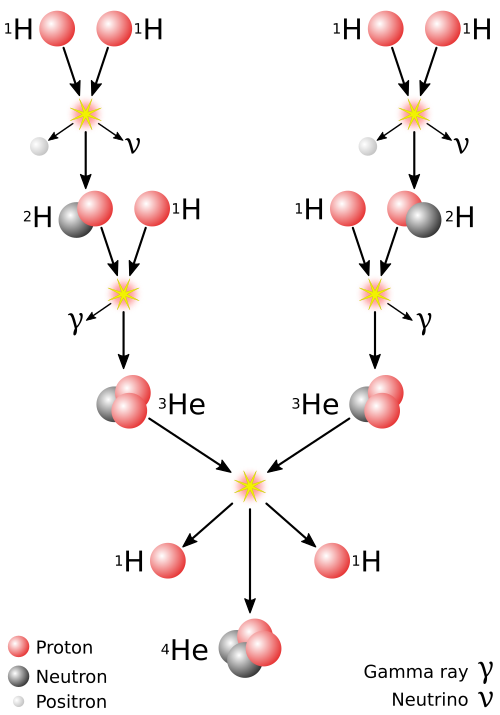
The PPI branch is the most common way that the reaction occurs in our Sun, as well as in similar-sized stars. It starts with protons colliding to create Deuterium, also known as Hydrogen-2, a hydrogen nucleus that contains both a proton and a neutron. The extra charge from the second proton is carried away by a positron and additional energy is carried away by a Neutrino. The Deuterium then collides with a third proton, leaving Helium-3 and emitting a Gamma Ray.
The Helium-3 nucleus then collides with a second Helium-3 that was created in the same way as the first. This creates a stable Helium-4 nucleus and frees two protons to start reactions elsewhere in the star. If we look at the input and output of this reaction, we can see that six protons go in, and a helium nucleus, two protons, two positrons, two neutrinos and two gamma rays come out.
Even though this is how most reactions occur in medium-sized stars, things sometimes go differently. With all the different kinds of particles churning about inside the star, they often combine in a slightly different sequence.
The PPII Branch

Sometimes, the Helium-3 atom from the PPI Branch crashes into a Helium-4 atom before it finds another Helium-3. When this occurs, we end up with a particle made up of four protons and three neutrons. That makes this atom Beryllium-7. This kind of Beryllium, however, is very unstable. In order to become more stable, it will try to absorb an electron, which has a negative charge. This cancels out the charge from one of the protons, transforming it into a neutron and sending out a neutrino. The resulting particle still has an atomic weight of seven, but only has a positive charge of three, making it Lithium-7.
When Lithium-7 is struck by a proton, it creates two stable Helium-4 nuclei. Although this chain reaction is less common in our sun than the PPI Branch, it is more common in stars that burn hotter.
The PPIII Branch
 If the unstable Beryllium-7 from the PPII Branch is hit by a proton before it can find a free electron, it becomes Boron-8. Like many other particles created in fusion reactions, Boron-8 is very unstable. It soon decays into Beryllium-8 by emitting a positron and a neutrino.
Beryllium-8 also happens to be very unstable. Since it has four protons and four neutrons, it splits into two very stable Helium nuclei only fractions of a second after being formed.
Like the PPII Branch, the PPIII Branch doesn’t account for much of the fusion taking place in the Sun. It generally occurs at even higher temperatures than the PPII Branch, which means that very hot stars are likely to have a great deal of Helium being created by the PPIII Branch of the Proton-Proton Chain.
The CNO Cycle
In the Proton-Proton Chain, Helium nuclei are created from nothing but protons. In more massive stars, however, the protons sometimes get a little help along the way. The Carbon-Nitrogen-Oxygen Cycle, or CNO Cycle, uses carbon, nitrogen and oxygen atoms to complete the process. These helper atoms are called catalysts. As with the Proton-Proton Chain, the CNO Cycle still takes in protons and puts out helium. No new carbon, nitrogen or oxygen are created in the process. Instead, these heavier elements absorb the protons, change two of them to neutrons, then throw out stable helium nuclei (along with a bunch of neutrinos, positrons and gamma rays).
As the catalyst atoms absorb and release other particles, they transform between different types of carbon, nitrogen and oxygen. Although these catalyst atoms will fuse with protons, they don’t fuse with each other at this stage because carbon burning takes much more energy than hydrogen burning.
Like the Proton-Proton Chain, the CNO Cycle has a number of different branches that the particles can take in order to get to stable Helium nuclei. Astrophysicists have discovered around seven different branches to the CNO Cycle.
Helium Burning
While a star is in the Main Sequence, most of its energy comes from Hydrogen Burning, which combines hydrogen atoms and turns them into helium, which builds up in the star’s core. Helium is a very stable atom. Although Helium atoms sometimes collide with one another, the resulting atom, Beryllium-8, doesn’t last very long, and will quickly decay back into two helium atoms.
When a star grows old and its core begins to collapse, the helium in the core gets hotter and more compressed. That means that the helium is moving faster in a smaller amount of space. This means that collisions between helium atoms will become more frequent. Although Beryllium-8 is still very unstable, reactions begin taking place so fast that the Beryllium will start fusing with other helium atoms before it has a chance to decay. This creates Carbon-12, another stable element.
Burning Carbon and Heavy Elements
In the most massive stars, elements heavier than helium can also be fused. When the helium in the core of such a star is depleted, it will undergo another core collapse, creating enough heat and pressure to ignite carbon burning. When carbon in the core is depleted, a core collapse will initiate Neon burning.
Page source under Creative Commons Attribution-Share Alike